HyperMarkdown
A streaming-native Markdown renderer for React that caches already-rendered blocks instead of re-parsing the whole message on every token, built for LLM chat interfaces.
🔗 Visit HyperMarkdown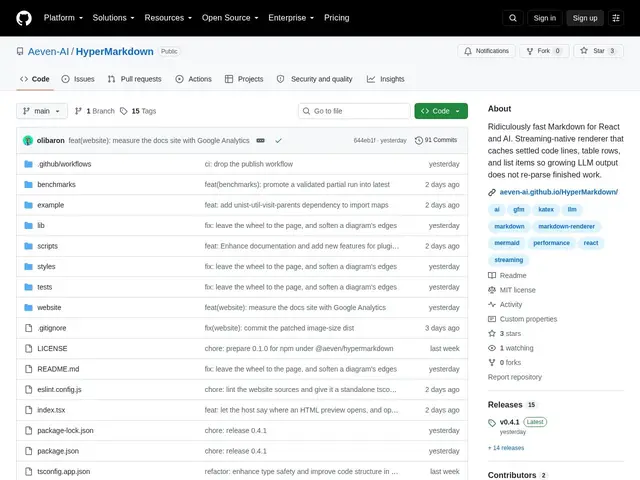
Description
When an AI chatbot is still typing out its answer, the raw Markdown streaming in — half-finished bold text, an incomplete code fence, a stray asterisk — has to be turned into readable formatting on the fly, every few milliseconds, without the whole message flickering or jumping around. Doing that naively means re-parsing the entire message from scratch on every new token, which gets slow and visually jittery as replies grow longer. HyperMarkdown is a rendering library built specifically for this situation.
HyperMarkdown is a streaming-native Markdown renderer for React that keeps already-rendered ("settled") blocks cached and only re-renders the part of the message still actively changing, instead of re-parsing the full document on every token. Its own benchmarks claim 1.8×–11.0× faster rendering than competing solutions on incomplete streams. It ships GitHub Flavored Markdown support, optional KaTeX math and Mermaid diagrams, HTML sanitization, and special handling for <think>/<reasoning> tags used by reasoning models, and targets React 18+ and Next.js App Router with SSR support.
💬 Our review
The short version: if you're building a chat UI that streams LLM output token-by-token, HyperMarkdown solves a real and annoying rendering problem — most generic Markdown renderers either re-parse the whole message on every token (slow, visible flicker) or need custom hacks to avoid it.
Compared to plain react-markdown, which wasn't designed for streaming and re-renders the full tree on each update, HyperMarkdown's sub-block caching is a meaningful architectural edge for high-frequency AI chat interfaces. Newer streaming-focused competitors like Vercel's streamdown cover similar ground, so the real differentiators come down to plugin ecosystem (KaTeX, Mermaid, syntax highlighting) and how well it handles edge cases like AI reasoning tags out of the box — both areas where HyperMarkdown is ahead. It's free, MIT-licensed, and React-only, so teams on Vue, Svelte, or vanilla JS can't use it directly. Worth adopting if you're already streaming LLM output into a React app and fighting render jank; overkill if you're just rendering static Markdown.
💰 Pricing
📊 Global score
🤖 AI-enriched data
Open source, licence MIT — aucun coût.
Pros
Cache par sous-bloc évite le re-parsing complet à chaque token
1.8×-11.0× plus rapide que les alternatives sur du contenu incomplet (benchmarks du projet)
Support des balises de raisonnement IA (<think>, <reasoning>)
Écosystème de plugins riche (KaTeX, Mermaid, coloration syntaxique)
Compatible React 18+ et Next.js App Router (SSR)
Cons
Réservé à l'écosystème React — pas de version Vue/Svelte
Utile seulement pour du contenu qui stream réellement, sur-dimensionné pour du Markdown statique
Projet jeune, communauté encore restreinte comparée à react-markdown