Lanes
A system enabling multiple Claude Code chats to coordinate asynchronously through shared message files for collaborative agent workflows. Leverages prompt caching to reduce token costs by 90% when reactivating worker agents.
🔗 Visit Lanes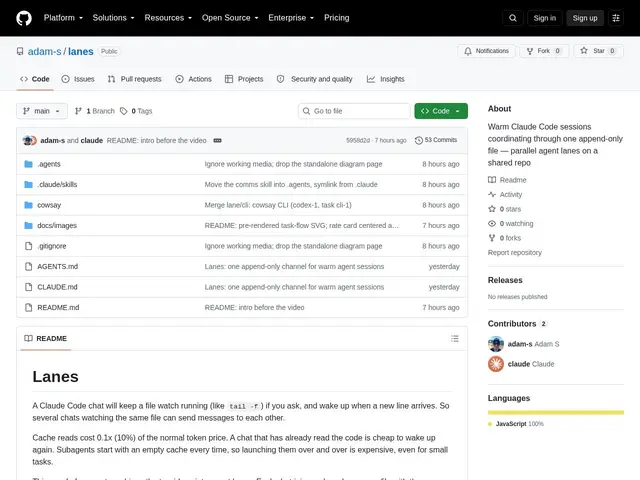
Description
If you've ever tried running several AI coding assistants at once on different parts of a project, you've probably hit the same wall: every time you start a new one, it has to re-read the whole context from scratch, which costs time and money. Lanes is a small coordination layer that keeps those AI sessions "warm" and talking to each other through shared files, instead of restarting them cold every time.
Lanes lets multiple Claude Code sessions coordinate asynchronously through shared append-only message files, with an orchestrator distributing tasks to specialized worker roles (reviewer, UI developer, etc.) that each work in an isolated git worktree to avoid conflicts. Because it reactivates existing warm sessions via file-watching rather than spawning fresh ones, it leverages Anthropic's prompt-caching discount (roughly 90% cheaper on cache reads) instead of paying full price for context on every worker activation.
💬 Our review
The short version: Lanes is a thin, clever piece of glue — it doesn't add new AI capability, it makes running several Claude Code agents in parallel meaningfully cheaper and less chaotic.
The alternative most teams reach for today is manually juggling several terminal tabs or tmux panes, each running its own Claude Code session with no coordination and no cost optimization — which works, but wastes tokens on redundant context reloading and gives you no structured way for agents to hand off work. Lanes' file-based message-passing and git-worktree isolation solve the coordination half, and cache-aware session reactivation solves the cost half, but it's a young, single-maintainer open-source project rather than a supported product, so expect some rough edges and manual setup. If you're already running multiple Claude Code sessions on a non-trivial project, Lanes is worth trying purely for the cache-cost savings; if you only ever run one agent at a time, there's nothing here for you.
💰 Pricing
📊 Global score
🤖 AI-enriched data
Gratuit, code source ouvert sur GitHub, aucune offre commerciale.
Pros
Réduction de coût via le cache de prompt (~90% sur les relectures)
Isolation par git worktree, pas de conflits entre agents
Rôles d'agents spécialisés (reviewer, UI, etc.)
Fonctionne aussi avec d'autres outils via instructions explicites
Cons
Projet jeune, mono-mainteneur, pas de support officiel
Configuration manuelle requise, pas de produit clé en main
Utilité limitée si vous ne faites tourner qu'un seul agent à la fois