Manzanas
Orchestrates iOS simulator fleets on macOS, enabling multiple AI agents to simultaneously drive simulators without conflicts using TTL-bounded exclusive leases and warm pool management.
🔗 Visit Manzanas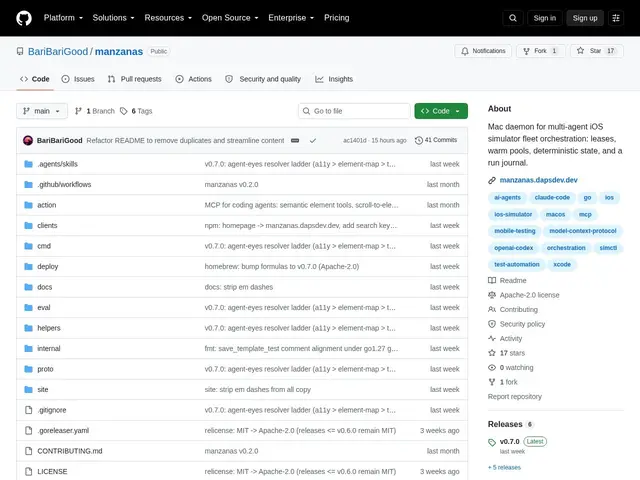
Description
As AI coding agents get used to test mobile apps, a new bottleneck shows up: iOS Simulators are slow to boot and can't safely be shared between multiple agents working at once without them tripping over each other. Manzanas is a small orchestration layer for a Mac that solves exactly that — it keeps a pool of simulators warm and ready, and hands them out to whichever agent needs one next, one at a time.
Manzanas runs a central daemon (manzanasd) that manages a fleet of iOS simulators on macOS, issuing TTL-bounded exclusive leases through a FIFO queue so multiple AI agents (Claude Code, Cursor, Codex) or CI jobs can share the same Mac without conflicts. By keeping simulators warm via SIGSTOP/SIGCONT instead of cold-booting them each time, it reportedly cuts lease-to-live time from about 7 seconds to 0.28 seconds and action execution from ~950ms to ~36ms, and adds MJPEG streaming, a browser dashboard, physical iPhone support via WebDriverAgent, and MCP integration for agent access.
💬 Our review
The short version: Manzanas solves a very specific, very real problem — AI agents can't safely share iOS Simulators without a broker — and the reported speedups (7s to 0.28s lease time) suggest the warm-pool approach genuinely works.
Cloud device farms like BrowserStack App Automate or Sauce Labs solve a different problem (access to real/virtual devices without owning a Mac fleet), but they're not designed for the specific pattern of several coding agents hammering a shared local simulator pool with sub-second lease turnover; Appium-style automation, meanwhile, drives a simulator but doesn't manage contention between multiple concurrent clients. Manzanas' niche is that in-between: local Mac fleets, shared by agents rather than humans, with deterministic queuing. It's an early open-source project (Apache-2.0, single-team maintained) so production reliability at scale is still unproven, and it only helps if you're already running multiple AI agents against iOS Simulators on your own Mac hardware — for a single developer or a single simulator, it's unnecessary overhead.
💰 Pricing
📊 Global score
🤖 AI-enriched data
Gratuit, licence Apache 2.0, aucune offre commerciale.
Pros
Réduit le temps d'obtention d'un simulateur de ~7s à ~0.28s
File d'attente FIFO avec baux à durée limitée, zéro conflit
Support iPhone physique via WebDriverAgent
Intégration MCP pour un accès natif par les agents IA
Gratuit et open source (Apache 2.0)
Cons
Projet jeune, fiabilité en production non encore éprouvée à grande échelle
Utile uniquement si plusieurs agents partagent une flotte de simulateurs
Nécessite une infrastructure Mac dédiée