AgentDisplay
Real-time monitoring platform for AI agents. Provides UUID-based shareable dashboards to visualize agent activity, status updates, and messages without authentication or complex setup.
🔗 Visit AgentDisplay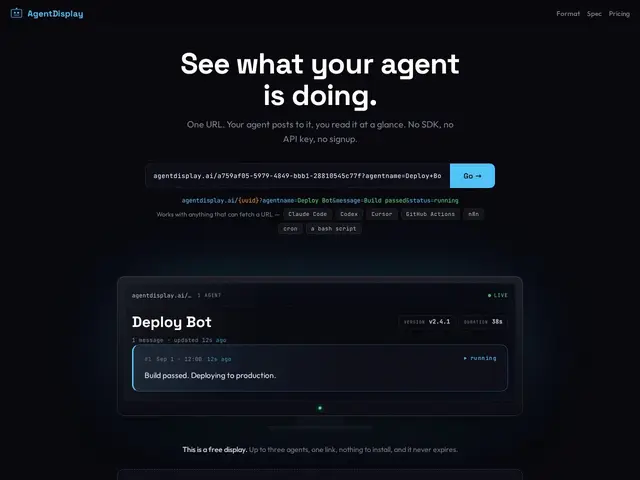
Description
When you kick off a long-running AI agent — one that might take minutes to hours to finish a task — the hardest part is often just knowing what it's doing right now without setting up a full monitoring stack. AgentDisplay's idea is as simple as a shared Google Doc link: any script or agent posts its status to a URL, and anyone with that link can watch it live, no login required.
AgentDisplay is a real-time monitoring platform for AI agents built around UUID-based shareable display URLs — no authentication, no complex setup. Any URL-capable tool (Claude, GitHub Actions, bash scripts, n8n workflows) can post status updates and messages to a display, which supports hierarchical views (orchestrators overseeing sub-agents), custom stat cards, and layouts for desktop, mobile, or wall displays. It automatically strips sensitive parameters (tokens, keys, secrets, JWTs) from posted data, and sends email alerts on error or blocked states.
💬 Our review
The short version: AgentDisplay deliberately trades depth for speed — you get a live status view in the time it takes to curl a URL, at the cost of the deep tracing and analytics a real observability platform like LangSmith provides.
Full LLM observability tools capture every trace, token, and reasoning step for later analysis; AgentDisplay isn't trying to compete there — it's closer to a lightweight, purpose-built status page for a single agent run, more like posting to a Slack channel but with a persistent, shareable URL and structured status fields instead of scrolling text. Generic status-page tools (Statuspage.io and similar) are built for service uptime, not for an individual agent's in-flight progress, so they're a worse fit for this specific use case. The free tier's 24-hour history and 3-agent cap will be plenty for occasional use but too thin for teams running many agents daily, at which point the $9 or $39/month plans become relevant. Good fit if you want instant visibility into a running agent without standing up infrastructure; not a replacement for real observability if you need to debug why an agent failed after the fact.
💰 Pricing
📊 Global score
🤖 AI-enriched data
Gratuit (3 agents, historique 24h) ; Personal 9 $/mois (10 agents, historique 7 jours) ; Team 39 $/mois (agents illimités, historique 30 jours, alertes Slack/webhook).
Pros
Zéro configuration, lien partageable façon Google Docs
Compatible avec n'importe quel outil capable d'appeler une URL
Filtrage automatique des paramètres sensibles (tokens, clés, secrets)
Vue hiérarchique orchestrateur/sous-agents
Palier gratuit exploitable pour un usage occasionnel
Cons
Pas de traçage détaillé ni d'analytics façon observabilité LLM complète
Historique limité sur le palier gratuit (24h, 3 agents)
Paliers payants nécessaires dès un usage équipe régulier