ReachPad Router
API that automatically finds and provisions the cheapest available cloud compute across multiple providers, billed per second, built for developers and AI agents that need short-lived machines fast.
🔗 Visit ReachPad Router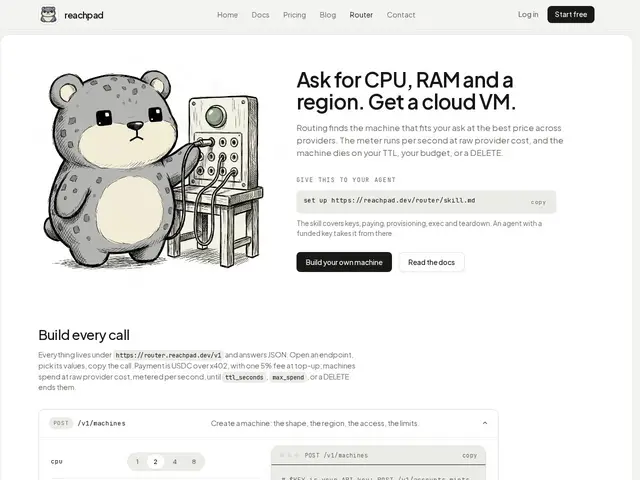
Description
Spinning up a cloud server usually means picking a provider, comparing instance prices, and committing to whatever you chose even if a better deal existed elsewhere. ReachPad Router automates that comparison shopping: tell it what CPU, RAM, disk, and region you need, and it finds and provisions the best-priced matching machine across multiple cloud providers automatically, billing you per second for exactly what you use.
ReachPad Router exposes a REST API (router.reachpad.dev/v1) that matches compute requirements to available instances across providers, then grants access via SSH or an HTTP exec endpoint depending on your workflow. Billing runs on a USDC-based, pay-as-you-go model at raw provider rates plus a 5% platform fee, with a $1.00 minimum top-up; cost controls include max_spend and max_rate parameters plus automatic machine termination via TTL, which matters for short-lived or agent-driven workloads that could otherwise run up an unexpected bill. It supports idempotent operations via client_ref (safe to retry a request without accidentally provisioning twice) and wallet-based key recovery for account access. The target use case is explicitly ephemeral, on-demand compute — a script or an AI agent that needs a machine for minutes to hours, not a long-term server.
💬 Our review
The short version: ReachPad Router does for ephemeral compute what a flight-price aggregator does for plane tickets — automatically finds the best deal across providers — with per-second billing and hard spending caps that make it genuinely safe to hand to an autonomous script or AI agent.
The comparison points are cloud marketplaces and multi-cloud brokers (Vast.ai for GPU compute specifically, or general multi-cloud tools like Skypilot) that also aim to reduce manual provider comparison. ReachPad Router's specific angle — REST API access with SSH/HTTP exec, USDC billing, and explicit spend/rate caps designed for both human and AI-agent callers — targets a narrower, more automation-first use case than a general multi-cloud CLI tool. The tradeoff is that a young, aggregator-style platform depends entirely on the reliability and honesty of the underlying providers it routes to, and a 5% fee on top of provider rates, while modest, is a real cost compared to going directly to one provider you already trust. Worth using for genuinely ephemeral, agent-driven, or price-sensitive compute needs where automatic best-price routing pays for itself; go direct to a single provider (AWS, Hetzner, DigitalOcean) if you need a long-running server and value a direct support relationship over price optimization.
💰 Pricing
📊 Global score
🤖 AI-enriched data
Facturation à la seconde au tarif fournisseur + 5% de frais, paiement en USDC, minimum de rechargement 1 $
Pros
Routage automatique vers le meilleur prix multi-fournisseurs
Facturation à la seconde, transparente
Contrôles de coûts intégrés (plafonds de dépense/débit, TTL)
Conçu pour un accès humain et agent IA (API REST, SSH, HTTP exec)
Cons
Frais de plateforme de 5% en plus du tarif fournisseur
Dépend de la fiabilité des fournisseurs sous-jacents
Moins pertinent pour des serveurs long-terme qu'un fournisseur direct