Openheim
Open-source Rust runtime for building AI agents that can call multiple LLM providers, run tools safely, and plug into terminals, CLIs, or editors like Zed and Claude Code.
🔗 Visit Openheim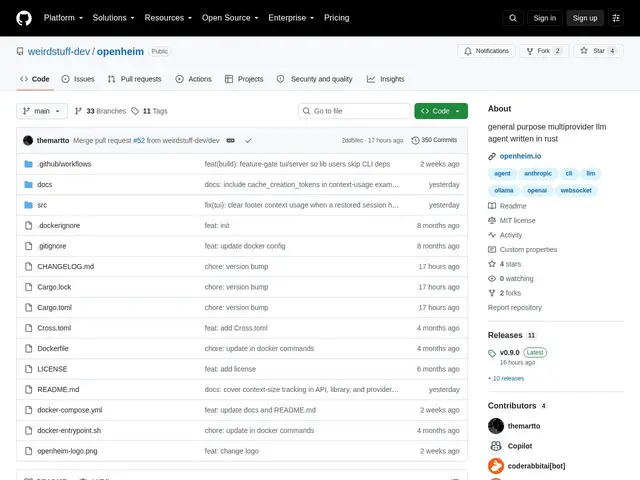
Description
Building an AI agent that can actually do things — run shell commands, edit files, browse the web — usually means gluing together a specific LLM provider's SDK with your own tool-execution code, and redoing that work if you ever want to switch providers or add another interface. Openheim is a free, open-source runtime that does that gluing for you: write your agent logic once, and it works across OpenAI, Claude, Gemini, Ollama, or any OpenAI-compatible endpoint, with tool execution, conversation history, and multiple front-ends (a terminal UI, a headless CLI, or a direct plug-in to editors like Zed and Claude Code) already built in.
Openheim is written in Rust and ships built-in tools for shell execution, file operations, directory listing, web fetching, and ripgrep-based search, alongside subagent delegation — spinning up isolated sub-agents with their own persona and even their own model choice for a subtask. It supports the Model Context Protocol (MCP) for surfacing external tools, configurable sandboxing to bound what an agent can touch on disk, and full conversation persistence with tool-call history across sessions. For editor integration specifically, it implements the Agent Client Protocol (ACP) over both stdio and WebSocket, which is what lets it plug directly into editors like Zed rather than requiring a custom integration per editor. It's MIT-licensed, ships a multi-stage Dockerfile, and has no commercial tier.
💬 Our review
The short version: Openheim is a solid, free alternative to rolling your own agent-orchestration layer, and its multi-provider-plus-editor-protocol combination (MCP in, ACP out) is a genuinely practical design for anyone tired of provider lock-in.
This space has real competition — LangChain/LangGraph, AutoGen, and CrewAI are the established Python-first agent frameworks, while Aider and Continue.dev focus more narrowly on coding-agent editor integration. Openheim's differentiators are being Rust-native (faster, lower memory, no Python dependency chain to manage) and building editor integration via the open ACP standard rather than a bespoke plugin per editor, plus first-class MCP support for tool interoperability. The tradeoff: Python frameworks like LangGraph have a much larger ecosystem of pre-built integrations, tutorials, and community examples, and Rust as an extension/customization language has a steeper learning curve for teams used to Python. Worth adopting if you want a fast, dependency-light agent runtime with native multi-provider and multi-editor support; stick with LangGraph or CrewAI if your team is Python-first and values ecosystem breadth over raw performance.
💰 Pricing
📊 Global score
🤖 AI-enriched data
100% gratuit et open source (MIT), aucune offre commerciale
Pros
Support multi-fournisseurs LLM natif (OpenAI, Claude, Gemini, Ollama...)
Écrit en Rust : rapide, faible empreinte mémoire, pas de dépendance Python
Intégration éditeur via le standard ouvert ACP (Zed, Claude Code)
Support MCP intégré, sandboxing configurable
Cons
Écosystème d'intégrations plus restreint que LangGraph/CrewAI (Python)
Courbe d'apprentissage Rust plus raide pour les équipes Python
Projet plus jeune, communauté plus petite