Noctovisor
Third-party risk monitoring SaaS that watches public records, court filings, and regulatory notices for the vendors and suppliers you do business with, and emails you when something changes.
🔗 Visit Noctovisor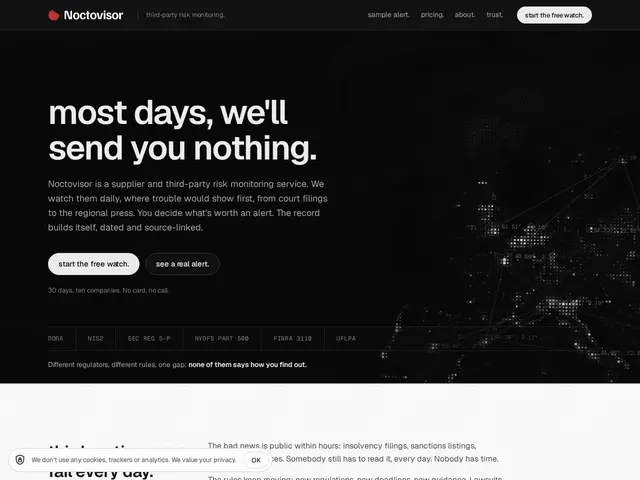
Description
If your company works with outside vendors, suppliers, or partners, you're supposed to know if one of them gets sued, sanctioned, or flagged by a regulator — but checking that manually for dozens or hundreds of companies is a job nobody wants. Noctovisor automates that watch: you give it a list of companies, it checks public records and court filings on them every day, and it emails you the moment something relevant shows up, with a dated, source-linked paper trail you can hand to an auditor.
Noctovisor targets financial institutions, regulated organizations, and enterprises that need documented third-party due diligence rather than one-off vendor questionnaires. It performs daily monitoring across public records and court filings with legal-entity matching and identifier verification, produces two-year baseline reports on enrolled companies, and supports multi-language source monitoring. Reporting is built around specific compliance frameworks — DORA, NIS2, SEC Reg S-P, NYDFS, FINRA, UFLPA — with weekly watch logs and monthly compliance reports designed to be audit-ready out of the box. Alert volume is deliberately capped at one email per company per day to avoid drowning users in noise.
💬 Our review
The short version: Noctovisor replaces the annual vendor-risk questionnaire with continuous, dated, source-linked monitoring — a real improvement for compliance teams, at a price that puts it firmly in enterprise-budget territory.
Third-party risk management has an established enterprise tier (OneTrust, Prevalent, UpGuard) that typically bundles vendor questionnaires, security ratings, and risk scoring into broader GRC platforms costing tens of thousands of dollars a year. Noctovisor's angle is narrower and more specific: automated public-records and court-filing monitoring mapped directly onto named compliance frameworks (DORA, NIS2, FINRA, etc.), which is a lighter, more focused offering than a full GRC suite. The tradeoff is exactly that narrowness — it doesn't do security ratings, questionnaires, or the broader risk-scoring features a platform like UpGuard or OneTrust bundles in, and at $499–$1,499/month plus a $30k/year unlimited tier, it's priced for regulated mid-market and enterprise budgets, not small businesses. Worth it if continuous, audit-ready third-party monitoring against named regulatory frameworks is specifically what you need; if you need broader vendor risk scoring and questionnaire management too, a full GRC platform will cover more ground for a higher price.
💰 Pricing
📊 Global score
🤖 AI-enriched data
À partir de 499 $/mois (50 entreprises), jusqu'à 30 000 $/an en illimité ; essai gratuit de 30 jours (10 entreprises)
Pros
Surveillance quotidienne automatisée des dossiers publics et judiciaires
Rapports mappés sur des cadres réglementaires nommés (DORA, NIS2, FINRA...)
Documentation datée et sourcée, prête pour audit
Alerting plafonné pour éviter la surcharge
Cons
Tarif enterprise, hors de portée des petites structures
Périmètre plus étroit qu'une plateforme GRC complète (pas de scoring de sécurité ni de questionnaires fournisseurs)
Pas d'alternatives directement comparables citées par l'éditeur