Malinois
Open-source iPhone app that turns your phone into a tamper detector — arm it before leaving a device unattended and it logs and photographs any attempt to move, tilt, or access it.
🔗 Visit Malinois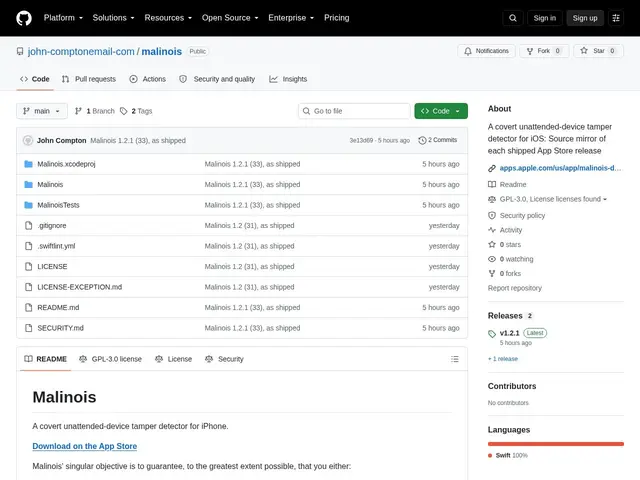
Description
Ever left your phone or laptop unattended in a hotel room, a shared office, or with a stranger, and wondered afterward whether anyone touched it while you were gone? Malinois is a free iPhone app built to answer exactly that question. Arm it, walk away, and if the device is moved, tilted, unplugged, or touched, it silently logs the event and takes a photo — so when you come back, you either know nothing happened, or you have evidence that it did.
Once armed with a PIN and (recommended) iOS Guided Access enabled, Malinois monitors motion, tilt, and accessory-connection sensors, going to a black "asleep" screen so no would-be intruder can tell it's active. Any tripwire event — movement, an attempt to close the app, disconnecting a cable — is written to a PIN-gated, timestamped Event Log with photo/video capture, with no delete path for an adversary trying to cover their tracks. It's developed transparently and published under GPL-3.0: the GitHub repo mirrors the exact source of every shipped App Store release, plus a SECURITY.md documenting the full threat model and known limitations, so security-conscious users can verify the app's claims rather than take them on faith. Core detection, capture, and logging are free forever; an optional Pro in-app purchase adds cloud backup of evidence, cross-device alerts, and extra sensor types. The developer is explicit that this is a personal anti-tampering tool for your own device — not a tool for monitoring other people without their consent.
💬 Our review
The short version: Malinois does one narrow job — proving whether your unattended device was touched — and does it with an unusually transparent, published threat model for a one-person side project.
Purpose-built "leave my device and know if it was touched" apps are a thin category; the closer comparisons are general anti-theft/Find My tools (which track a stolen device after the fact but don't prove tampering while it sat unattended) or DIY tripwire setups built from smart-home sensors. Malinois's differentiator is a published, testable threat model (SECURITY.md, unit tests pinned to security rules, source mirrored per release) — a level of transparency most consumer security apps from small developers don't bother with, and one explicitly built with AI-assisted development that the author discloses rather than hides. The honest caveats: it's a solo project with no bug bounty program and no SLA, iOS's lack of reproducible builds means the source mirror can't cryptographically prove the App Store binary matches this code, and it protects against physical tampering only — it does nothing for remote or network-based compromise. Worth arming any time you're leaving a phone or laptop somewhere you don't fully trust (hotel room, shared desk, border crossing); it's the wrong tool if what you actually need is theft recovery or malware protection, which call for Find My/anti-theft and endpoint security tools respectively.
💰 Pricing
📊 Global score
🤖 AI-enriched data
Détection, capture et journal local gratuits à vie ; achat intégré Pro en option (sauvegarde cloud, alertes multi-appareils, capteurs additionnels), essai 30 jours inclus
Pros
Cœur de fonctionnalité (détection+capture+log) gratuit à vie
Threat model documenté et transparent (SECURITY.md, tests unitaires liés aux règles de sécurité)
Code source mirrored à chaque release App Store, vérifiable
Open source (GPL-3.0)
Cons
Projet solo, pas de programme de bug bounty ni de SLA
iOS ne permet pas de build reproductible : impossible de prouver cryptographiquement que le binaire App Store correspond au code du repo
Protège seulement contre l'altération physique, pas contre une compromission réseau/logicielle