OtaKit
OtaKit enables developers to push over-the-air updates directly to Capacitor apps without app store reviews, delivering updates to devices within seconds.
🔗 Visit OtaKit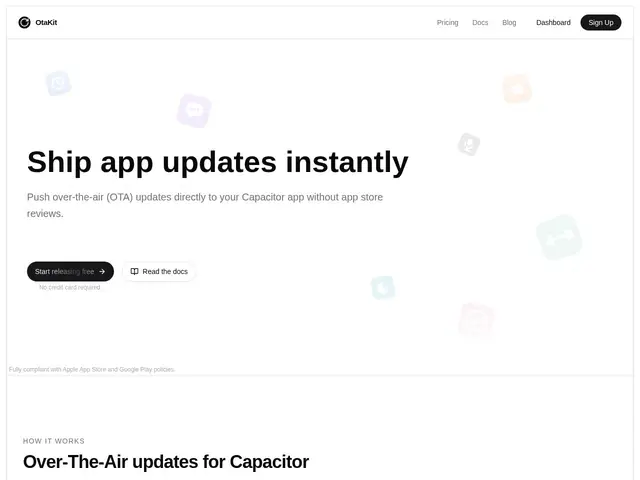
Description
Fixing a bug in a mobile app usually means submitting a new build to Apple and Google and waiting anywhere from a few hours to several days for review — painful if you just need to fix a typo or patch something broken in production. OtaKit is built for apps made with Capacitor (a popular framework for turning web apps into mobile apps) and lets you push updates to the app's web layer directly to users' devices in seconds, completely bypassing the app store review queue for that class of change.
OtaKit works by delivering delta updates (only the changed bytes, not a whole new app) through channel-based release management — production, beta, or custom channels — so teams can stage rollouts safely, with automatic rollback if an update fails. It ships a real-time dashboard for monitoring releases and device activity, a CLI-based deployment workflow that fits into existing CI/CD pipelines, and signs every update with SHA-256 verification for integrity. It's freemium: free up to 5,000 updates a month, $10/month for 100,000, $25/month (billed yearly) for 1 million, and custom Enterprise pricing, with a self-hostable open-source core for teams that want to run it themselves.
💬 Our review
The short version: OtaKit does for Capacitor apps what CodePush famously did for React Native — near-instant updates without waiting on app store review — and it's priced to be a no-brainer for small teams while staying open enough (self-hostable core) not to lock in larger ones.
The category isn't new — Microsoft's CodePush proved the model years ago before its eventual retirement, which left a gap for React Native and Capacitor teams that OtaKit and a few competitors (Capgo, for instance) are now filling specifically for Capacitor. What differentiates OtaKit here is the combination of a genuinely usable free tier (5,000 updates/month covers a lot of small apps), delta updates to keep bandwidth low, and an open-source self-hostable core, which matters if you're wary of a vendor disappearing the way CodePush effectively did. The obvious limitation is scope: OTA updates only cover the web/JS layer, not native code changes, which still require a real app store submission — so it complements rather than replaces your release process. Worth adopting if you ship a Capacitor app and want to stop waiting days for minor fixes; irrelevant if you're not on Capacitor, since this doesn't apply to native-only or Flutter apps.
💰 Pricing
📊 Global score
🤖 AI-enriched data
Gratuit (5K mises à jour/mois) · Starter 10 $/mois (100K) · Pro 25 $/mois facturé annuellement (1M) · Enterprise sur devis
Pros
Mises à jour livrées en quelques secondes, sans passer par la review des stores
Mises à jour delta (bande passante minimisée) + rollback automatique en cas d'échec
Noyau open source et self-hostable, pas de dépendance totale au SaaS
Palier gratuit généreux pour les petites apps (5K mises à jour/mois)
Cons
Ne couvre que la couche web/JS de l'app — le code natif nécessite toujours une soumission classique
Uniquement pour les apps Capacitor, pas pertinent pour Flutter/natif pur
Marché déjà occupé par des alternatives comme Capgo