Rust Glancer
A lightweight Rust language server that stays under 100MB of RAM by keeping indexed code data on disk instead of in memory.
🔗 Visit Rust Glancer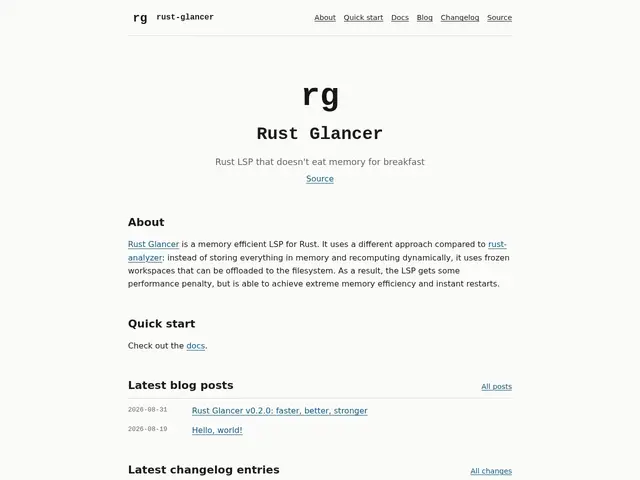
Description
rust-analyzer, the standard Rust language server, gives your editor features like autocomplete and go-to-definition, but it can eat well over a gigabyte of RAM on large codebases and takes a noticeable moment to rebuild its index every time you restart your editor. Rust Glancer is a smaller, more frugal alternative aimed at people who don't have RAM to spare — old laptops, cloud dev environments with tight memory limits, or just running many editor windows at once.
It keeps idle memory use under 100MB by storing indexed workspace data on the filesystem rather than holding it all in memory, which also means editor restarts are fast since the cache is already there on disk. To hit that footprint it uses approximation techniques for analyzing unsaved code changes rather than the fully precise incremental analysis rust-analyzer does, which is the explicit trade-off: less RAM and faster restarts, at the cost of some advanced language features and raw query precision. It's free and open source.
💬 Our review
The short version: if rust-analyzer's memory footprint is genuinely a problem for your setup — a resource-constrained VM, an old machine, or a dozen open editor windows — Rust Glancer is a real, free option built specifically for that.
It's honest about the trade-off it makes: filesystem-backed indexing and approximation-based analysis of unsaved changes buys you sub-100MB idle memory and fast restarts, but you give up some of rust-analyzer's precision and advanced features in return. For most developers on a modern laptop with 16GB+ of RAM, that trade isn't worth making — rust-analyzer's feature completeness and massive user base (meaning far more bug fixes and IDE integration polish) will usually win. This is a niche tool for a specific pain point, not a general replacement, and being a smaller open-source project it won't have the same breadth of testing across every possible Rust codebase. Worth trying if memory pressure is an actual, measured problem for you; stick with rust-analyzer otherwise.
💰 Pricing
📊 Global score
🤖 AI-enriched data
Open source, gratuit
Pros
Moins de 100 Mo de RAM au repos
Redémarrages rapides grâce au cache sur disque
Open source et gratuit
Alternative légitime pour environnements contraints en mémoire
Cons
Moins précis que rust-analyzer sur le code non sauvegardé (approximations)
Fonctionnalités avancées de langage plus limitées
Communauté et couverture de test plus restreintes que rust-analyzer
Peu d'intérêt si vous n'avez pas de contrainte mémoire réelle