gopdfrab
A fast, lightweight Go library and CLI that checks whether a PDF meets the PDF/A-1b long-term archival standard, and converts it if it doesn't.
🔗 Visit gopdfrab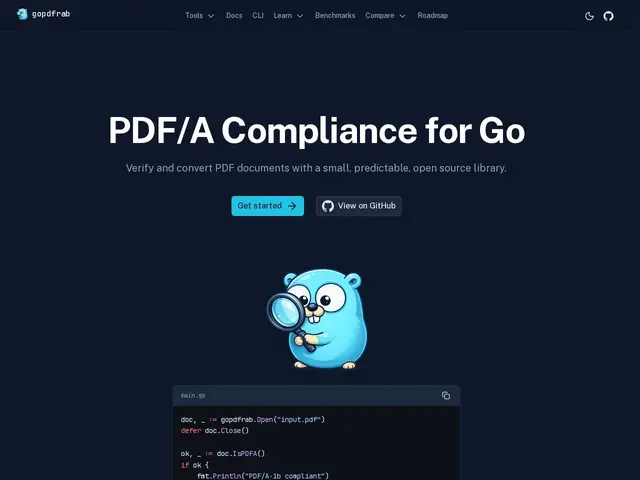
Description
Government agencies, courts, banks, and archives often require documents to be saved in PDF/A — a locked-down version of PDF designed to still open correctly in 20 or 50 years, without depending on external fonts or fragile features regular PDFs can use. Checking or converting files to meet that standard usually means running a slow, heavyweight Java tool. gopdfrab does the same job as a small, fast Go program instead.
It runs 159 individual compliance checks across 11 rule groups to validate PDF/A-1b conformance, and can convert a normal PDF into a compliant one with pre-emptive fixups, including support for encrypted PDFs (RC4, AES-128/256) and recovery of somewhat damaged documents. It ships as both a Go library (for embedding in your own pipeline) and a static CLI binary, plus a WebAssembly build for validating PDFs client-side in a browser. Benchmarked at roughly 2,939 files per second with about 80MB peak memory, it's positioned against established validators like PDFBox Preflight and veraPDF on raw performance and footprint. It's dual-licensed: free under AGPL 3.0 for open-source use, with a commercial license available for proprietary products.
💬 Our review
The short version: if you need to validate or convert PDFs to PDF/A-1b at scale — in a CI pipeline or a document-processing backend — gopdfrab is a genuinely fast, low-overhead alternative to the Java-based tools that have dominated this niche for years.
The performance numbers (2,939 files/sec, 80MB memory) are a real differentiator against veraPDF and PDFBox Preflight, both of which are notoriously heavy to run in a container or serverless function; a Go static binary or WASM build fits much more naturally into modern pipelines. The trade-off is licensing: AGPL 3.0 is copyleft, so if you're embedding it in a closed-source commercial product you'll likely need the paid commercial license rather than the free tier — budget for that conversation before you build a dependency on it. It's also a newer, narrower tool than the decade-plus-mature veraPDF, so if you need the absolute widest compliance-check coverage or ISO-certified validation for legal purposes, veraPDF still has more institutional trust behind it. Good fit for engineering teams building PDF/A checks into CI/CD or a document pipeline who care about speed and resource use; less of a fit if you need a GUI tool for one-off manual checks.
💰 Pricing
📊 Global score
🤖 AI-enriched data
Gratuit sous licence AGPL 3.0 pour l'open source ; licence commerciale disponible pour usage propriétaire (tarif non public)
Pros
Très rapide (~2 939 fichiers/sec) et léger (~80 Mo de RAM pic)
159 vérifications sur 11 groupes de règles pour la conformité PDF/A-1b
Disponible en librairie Go, binaire CLI statique et WebAssembly navigateur
Gère les PDF chiffrés et la récupération de documents endommagés
Cons
Licence AGPL 3.0 copyleft — usage propriétaire nécessite une licence commerciale payante
Outil plus récent et moins établi institutionnellement que veraPDF
Pas d'interface graphique pour des vérifications ponctuelles manuelles
Tarif de la licence commerciale non public