Executor
An open-source workflow framework that structures how AI coding agents move from idea to shipped code, splitting thinking from doing across clear phases.
🔗 Visit Executor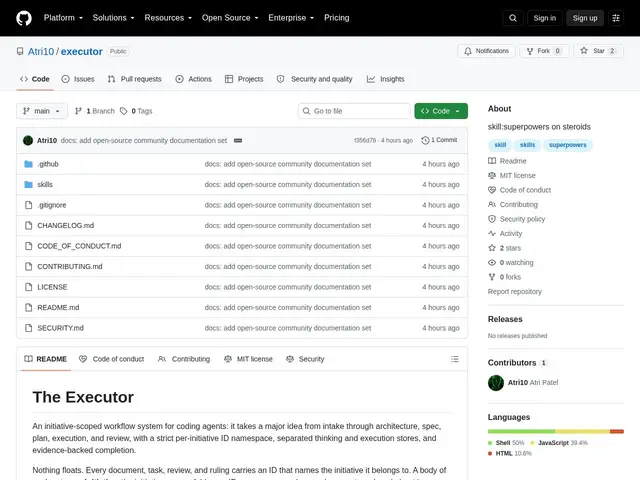
Description
AI coding agents like Claude Code or Cursor can go from a one-line request straight to writing code, which works fine for small tasks but tends to produce messy, hard-to-follow changes on anything bigger — the agent skips planning, mixes exploration with implementation, and leaves no trail of why it made the choices it made. Executor is a lightweight framework that imposes structure on that process: it forces the agent through distinct phases before it's allowed to touch code.
It defines a router with a dedicated initiative namespace ID, and compressible phases — discovery, architecture, specification, planning, execution, review — that separate thinking from doing using dedicated folders for each stage. It adds a granular addressing system for requirements so specific pieces of a spec can be referenced and tracked individually, plus safety checks before final delivery. It's free and open source (MIT license), distributed as a GitHub repo you install into your own agent workflow rather than a hosted product.
💬 Our review
The short version: if you've watched an AI coding agent barrel through a complex task without a plan and produce a change you can't fully trust, Executor's phase-gating idea directly addresses that, and it costs nothing to try.
The core idea — forcing separation between discovery/planning and execution, with a review phase at the end — is a sound and increasingly common pattern in the agentic coding space (several other tools take a similar approach), so the concept isn't unproven. What is unproven is this specific implementation: it's a single-maintainer GitHub project with no visible adoption numbers, so expect rough edges, and you should read the source before trusting it with sensitive workflows, as with any small open-source project in a fast-moving space. It also assumes you're comfortable configuring your agent harness around a specific folder/phase convention, which is more setup than just prompting the agent directly. Worth trying if you're already fighting agent output quality on multi-step tasks and want a structured, free option; if you just need occasional small AI-assisted edits, this is more process than you need.
💰 Pricing
📊 Global score
🤖 AI-enriched data
Open source, licence MIT, gratuit
Pros
Sépare clairement réflexion et exécution via des phases dédiées
Système d'adressage granulaire pour suivre les exigences individuellement
Contrôles de sécurité avant livraison finale
Gratuit et open source (MIT)
Cons
Projet mono-mainteneur, peu d'adoption visible
Nécessite de configurer son harnais d'agent autour de cette convention
Plus de setup que le prompting direct pour de petites tâches
Peu de retours d'usage en production à ce stade