SDD Observatory
Open, community-maintained directory tracking spec-driven development frameworks and real-world projects to evaluate their practical effectiveness.
🔗 Visit SDD Observatory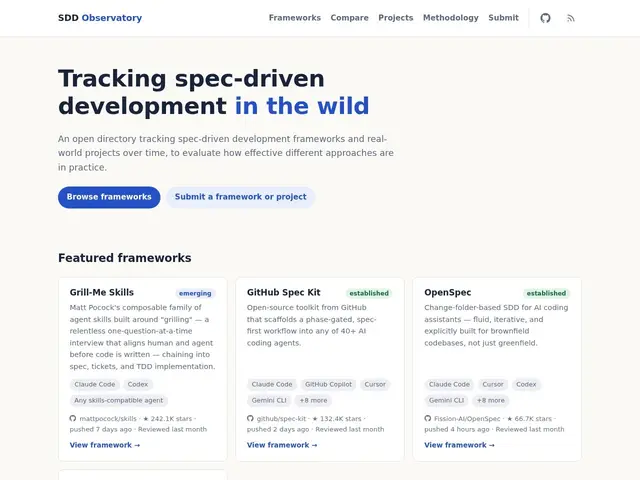
Description
If you've started using an AI coding assistant like Claude Code or Cursor with a written spec instead of just chatting your way to a feature, you've run into "spec-driven development" (SDD) — writing down what you want built before the AI starts coding. Several competing frameworks now promise to do this well, but almost none of them publish evidence that they actually work on real projects. SDD Observatory is a public scoreboard for that claim: it tracks the frameworks and the real codebases built with them, and lets the community judge which ones hold up in practice.
SDD Observatory is an open, community-maintained directory of spec-driven development frameworks (GitHub Spec Kit, OpenSpec, BMAD-Method, and others) paired with real-world projects built using each one. Each entry combines methodology documentation with implementation tracking — performance metrics, community reviews, and links back to the actual repositories — so visitors can compare frameworks on evidence rather than marketing claims. The project is fully open (MIT-licensed code, CC BY-SA 4.0 content) and accepts community submissions via an RSS-tracked feed.
💬 Our review
The short version: a useful, if thin, first attempt at answering a question nobody else is tracking — which spec-driven-development framework for AI coding agents actually holds up once real projects use it.
Against generic "awesome-list" GitHub repos that just link to frameworks without evaluation, SDD Observatory's edge is the pairing of each framework with tracked real-world implementations and a review layer — closer to evidence than to a link dump. The catch is that it's young and depends entirely on community submissions to stay current; with a small number of tracked projects so far, the sample size behind any given framework's "real-world effectiveness" claim is still thin, and the review system is qualitative rather than rigorously benchmarked. If you're choosing between SDD frameworks and want more than vendor claims, it's a legitimate first stop; treat its verdicts as directional, not definitive, until the dataset grows.
💰 Pricing
📊 Global score
🤖 AI-enriched data
Projet communautaire open source ; code sous licence MIT, contenu sous CC BY-SA 4.0. Aucune offre payante.
Pros
Associe chaque framework à des projets réels suivis
100% open source et gratuit
Documentation de méthodologie et critères d'évaluation publiés
Flux RSS pour suivre les nouvelles soumissions
Cons
Dépend entièrement des soumissions communautaires pour rester à jour
Échantillon de projets encore réduit derrière chaque verdict
Évaluation qualitative, pas de benchmark rigoureux standardisé