RecQL
Declarative, SQL-like query language for building recommendation systems and search platforms, compiling to run across PostgreSQL, MongoDB, SQL Server, Oracle, and MariaDB.
🔗 Visit RecQL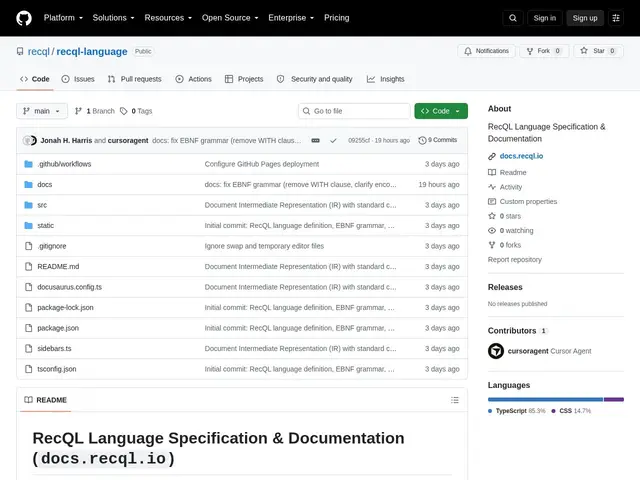
Description
Building a recommendation or search feature usually means writing separate, incompatible query logic for whichever database you happen to use — one way for PostgreSQL, another for MongoDB, another again if you add a vector store. RecQL proposes writing that logic once, in a SQL-like declarative language, and letting it compile down to whatever backend you're actually running.
RecQL is a declarative query language for building recommendation systems, search engines, and ranking platforms, with reference implementations across PostgreSQL, MongoDB, SQL Server, Oracle, and MariaDB. Queries compile to an intermediate representation (IR) executable on any supported backend, and RecQL supports multi-stage pipelines combining candidate generation, vector retrieval, lexical search, ML scoring, and diversity reordering — aimed at engineers building personalization, search, or ranking systems who want database portability without rewriting logic per backend.
💬 Our review
The short version: an ambitious, technically sound idea — one query language for recommendation/search logic across five different databases — that's still early enough to require some faith in a young project.
There's no direct equivalent doing cross-database declarative recommendation queries with this breadth; the usual alternative is hand-rolling backend-specific query and scoring logic, or adopting a single-vendor recommendation platform that locks you into one database. RecQL's honest risk is maturity: a formal EBNF spec and reference implementations are a serious foundation, but production track record and community size are both still unproven. If you're building multi-backend search/recommendation infrastructure and want to avoid vendor lock-in, it's worth prototyping with; if you need something battle-tested today, hand-rolled per-backend logic remains the safer default.
💰 Pricing
📊 Global score
🤖 AI-enriched data
Gratuit et open source, licence MIT.
Pros
Une seule syntaxe déclarative pour plusieurs bases (PostgreSQL, MongoDB, SQL Server, Oracle, MariaDB)
Pipelines multi-étapes : recherche vectorielle + lexicale + scoring ML + reranking
Spécification formelle EBNF du langage, pas juste une implémentation ad-hoc
Implémentations de référence fournies pour plusieurs backends
Cons
Projet jeune, écosystème et documentation encore limités
Nécessite d'apprendre un nouveau langage de requête en plus du SQL existant
Adoption en production non démontrée à grande échelle pour l'instant