K-Veritas
Cryptographic verification tool that binds computational results to their producing code, hardware, and execution time in signed, tamper-evident records.
🔗 Visit K-Veritas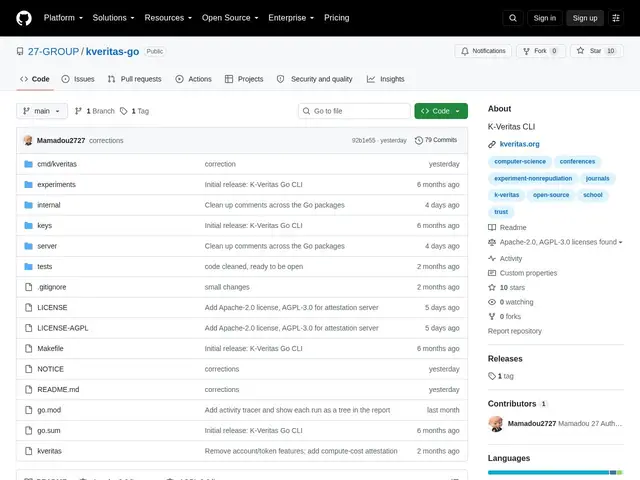
Description
When a research paper claims a machine-learning result, reviewers usually have to take the authors' word for it — there's rarely proof that the code, the hardware, and the reported numbers actually match up. K-Veritas tries to close that gap by cryptographically signing a computational result together with the exact code, hardware configuration, and execution time that produced it, turning "trust me" into something a reviewer can verify.
K-Veritas is a cryptographic verification tool that binds computational results to their producing code, hardware, and execution time inside signed, tamper-evident records (including exportable signed PDFs). It offers HMCA execution-coherence checking, compute-cost validation against FLOPs/resource bounds, a signed Merkle timeline with selective-disclosure proofs, and hash-chained agent session logging — aimed at researchers and ML practitioners who need non-repudiable proof of reproducibility for publications and peer review.
💬 Our review
The short version: a narrow but genuinely novel tool for a real problem — almost nothing else offers cryptographic, non-repudiable proof that a computational result was produced by specific code, hardware, and timing.
There's no direct competitor doing exactly this; the closest comparisons are general reproducibility practices (containerized environments, experiment-tracking tools like MLflow) which record what ran but don't cryptographically prove it wasn't altered afterward. K-Veritas's edge is that signed, tamper-evident proof; the cost is a steep learning curve and a niche audience — this is built for academic ML/research reproducibility, not general software verification, and the AGPL-3.0 server component adds licensing friction for commercial use. If you publish computational research and reviewers question reproducibility, it's worth evaluating; for everyday software teams it's overkill.
💰 Pricing
📊 Global score
🤖 AI-enriched data
Gratuit et open source ; CLI/protocole/bibliothèques sous Apache-2.0, composant serveur sous AGPL-3.0.
Pros
Preuve cryptographique liant résultat, code, matériel et heure d'exécution
Timeline Merkle signée avec preuves à divulgation sélective
Binaire statique unique, déploiement simple multi-plateforme
Licence permissive pour le CLI (Apache-2.0)
Cons
Cible très nichée (reproductibilité scientifique/ML), pas un usage grand public
Composant serveur sous AGPL-3.0, contraignant pour un usage commercial fermé
Jeune projet, peu d'adoption documentée en dehors du contexte académique