Rta-Smriti Brain
A free, open-source local memory system for AI coding agents that stores project decisions and context in SQLite, so you don't have to re-explain the same project to your agent every session.
🔗 Visit Rta-Smriti Brain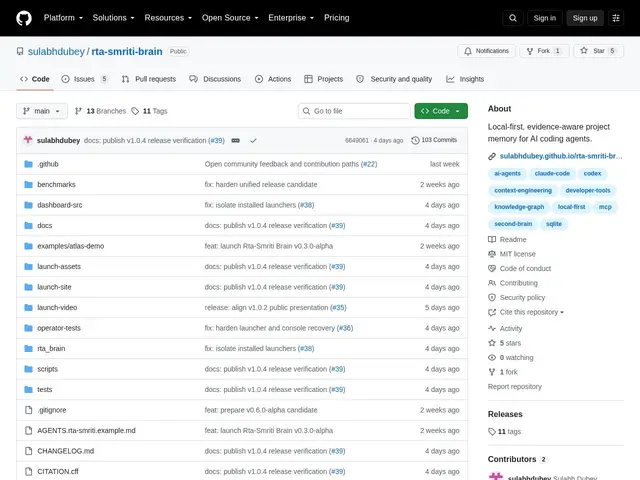
Description
Every new session with an AI coding agent often starts from zero — it doesn't remember why you chose a certain architecture last week or what constraints you already ruled out. Rta-Smriti Brain gives agents a persistent, local memory of a project's decisions and structure across sessions.
Rta-Smriti Brain indexes a repository's files, symbols, and imports into a local SQLite database, and stores durable memory of decisions and constraints using an evidence-classification system (called the Pramana model) to track how confident the recorded information is. It exposes this through an MCP server so agents like Claude Code, Cursor, or Codex can query it, includes a browser-based dashboard with graph visualization, generates focused 'context packs' for specific tasks, and keeps itself in sync with managed background updates and git-checkout awareness. It's free and MIT-licensed, with optional integration for local models.
💬 Our review
The short version: Rta-Smriti Brain tackles a genuinely annoying problem — re-explaining project context to an AI agent every session — and being free, local-first, and MIT-licensed makes it a low-risk tool to try if that friction bothers you.
The most common alternative today is a static CLAUDE.md or similar rules file that you maintain by hand — simple, but it doesn't grow automatically, doesn't track evidence/confidence, and doesn't index the actual code structure the way Rta-Smriti Brain's SQLite-backed graph does. Managed agent-memory infrastructure like Mem0 or Zep targets a broader, often multi-tenant SaaS use case (memory for AI products, not specifically a developer's own coding-agent workflow), so they're solving an adjacent but different problem at a different scale. If you're already maintaining a manual context file and finding it goes stale, Rta-Smriti Brain's automated indexing and evidence tracking is worth testing as a replacement; if you don't yet feel that pain, a simple markdown file may still be enough.
💰 Pricing
📊 Global score
🤖 AI-enriched data
Open source sous licence MIT, aucun coût
Pros
Indexation automatique du dépôt (fichiers, symboles, imports)
Système de classification de la confiance (modèle Pramana)
Serveur MCP pour intégration agent directe
Dashboard avec visualisation en graphe
Cons
Nécessite un dépôt local, pas de service hébergé
Projet jeune, communauté encore réduite
Courbe d'apprentissage pour le modèle d'évidence Pramana