SpendShield
A free, open-source guardrail that sits between an AI agent and payment APIs, enforcing spend limits, requiring human approval for unusual transactions, and logging every attempt.
🔗 Visit SpendShield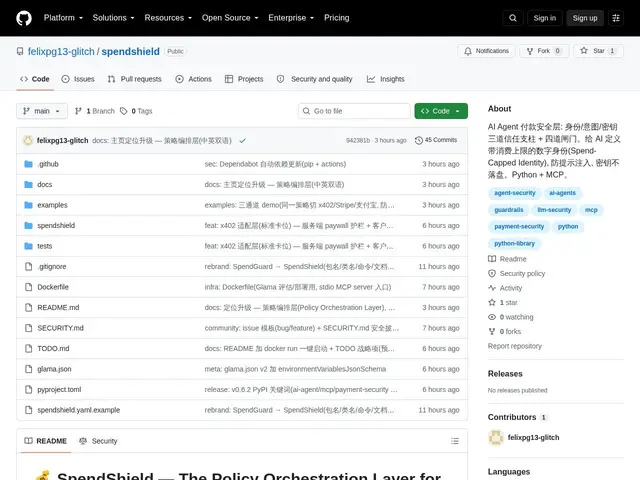
Description
Giving an AI agent the ability to actually spend money — book something, buy something, pay an API bill — is genuinely useful, but also genuinely risky if the agent misjudges a price or gets confused by a prompt injection. SpendShield adds a rule-enforcing layer between the agent and any payment system so mistakes get caught before money moves.
SpendShield gives each agent its own identity with configurable spend caps, requires human approval for new payment recipients or unusually large transactions, and stores API keys in an AES-256 encrypted vault. It supports a dry-run mode to preview transactions without executing them, enforces per-transaction limits and rate limits per agent, and logs every payment attempt and policy violation for audit. It integrates as an MCP server for Claude and compatible tools, and supports the x402 payment protocol. It's free and MIT-licensed.
💬 Our review
The short version: SpendShield addresses a specific, sharp risk — an AI agent with real payment access making an unintended purchase — with concrete deterministic controls, and being free and open source means there's no reason not to add it if your agent touches money at all.
Stripe's own Issuing controls let you set spend limits on virtual cards, which covers similar ground at the payment-rail level, but that's Stripe-specific and doesn't give you agent-level identity, per-agent audit logging, or dry-run previews the way SpendShield does. Newer 'agent payments' infrastructure like Skyfire is emerging to solve this at a broader, more commercial scale, but SpendShield's free, self-hosted, narrowly-scoped approach is a lower-commitment starting point. The realistic status quo for most teams right now is no guardrail at all — trusting the agent's own restraint — which is exactly the failure mode SpendShield's HN post referenced. If any of your agents have live payment API access, this is cheap insurance worth adding.
💰 Pricing
📊 Global score
🤖 AI-enriched data
Open source sous licence MIT, aucun coût
Pros
Plafonds de dépense configurables par agent
Approbation humaine requise pour transactions inhabituelles
Coffre-fort chiffré AES-256 pour les clés API
Mode dry-run pour prévisualiser sans exécuter
Cons
Nécessite une intégration technique (MCP, self-hosted)
Projet jeune, moins établi que les contrôles natifs Stripe
Pas de service géré, tout en self-hosted