SlideOps
Open-source tool that generates slide decks directly from a code repository and automatically flags slides whose code citations have gone stale, so documentation decks don't quietly drift from the actual codebase.
🔗 Visit SlideOps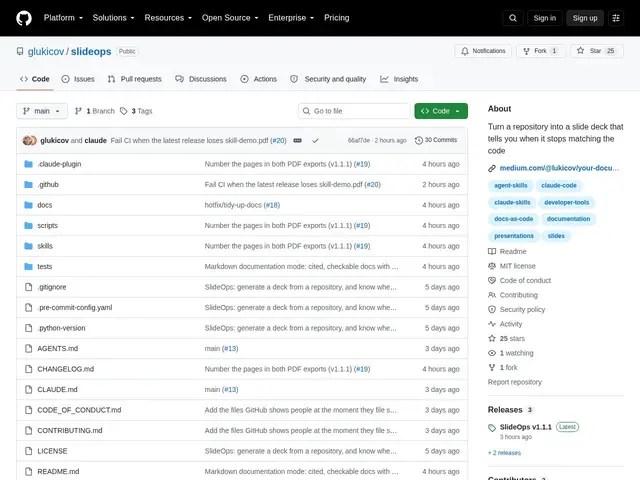
Description
Anyone who has presented an architecture deck three months after writing it knows the slides are usually already a little wrong — a function got renamed, a file got moved, and nobody updates the deck. SlideOps treats a slide deck like a build artifact instead of a one-time document: it's generated from the actual repo, and it can tell you when a slide is citing code that no longer exists.
SlideOps is a free, open-source (MIT) tool that turns a Git repository into a slide deck, then automatically checks whether the code citations in each slide are still accurate — flagging outdated references before you present something that's quietly wrong. It supports Markdown-based decks with citation verification, 13 slide patterns across 4 visual themes, Mermaid diagram support with pre-rendered SVGs, and PDF export with visual validation. Decks are self-contained single files that work offline, and it plugs into CI/CD so freshness checks run automatically on every commit, similar to a linter. It's built with Claude Code and compatible AI agents in mind for teams maintaining technical documentation.
💬 Our review
The short version: SlideOps solves a small but real and unglamorous problem — decks and diagrams that silently go stale — and does it for free with a CI integration that catches drift automatically instead of relying on someone remembering to update a slide.
General presentation tools like Google Slides, PowerPoint, or even developer-favorite Marp have no concept of "this code citation is now wrong" — they're static documents with zero connection to the repo they describe. SlideOps' actual differentiator is treating a deck as a build artifact with automated freshness verification, which is closer in spirit to a documentation linter than a presentation tool. As a young open-source project (24 stars at last check) it has a narrow feature set — 13 slide patterns and 4 themes is fine for internal technical walkthroughs but won't compete with PowerPoint or Google Slides on design flexibility for client-facing or highly visual presentations. Worth adopting specifically for internal architecture/onboarding decks that a team actually wants to keep accurate over time; overkill or the wrong tool if you just need a one-off pitch deck.
💰 Pricing
📊 Global score
🤖 AI-enriched data
Outil open source gratuit (licence MIT)
Pros
Gratuit et open source (MIT)
Vérification automatique de fraîcheur des citations de code
Intégration CI/CD, alerte à chaque commit
Fichiers autonomes fonctionnant hors ligne
Cons
Projet jeune, faible nombre d'étoiles GitHub
Choix de mise en page limité (13 patterns, 4 thèmes) face à PowerPoint/Google Slides
Pensé pour des decks techniques internes, pas des présentations client soignées