Cassis Context Bootstrap
Open-source tool that reads your existing dbt project, database schema, dashboards, and query logs, and automatically builds a structured map of your data's meaning — so an AI analytics agent has real context instead of guessing what a column means.
🔗 Visit Cassis Context Bootstrap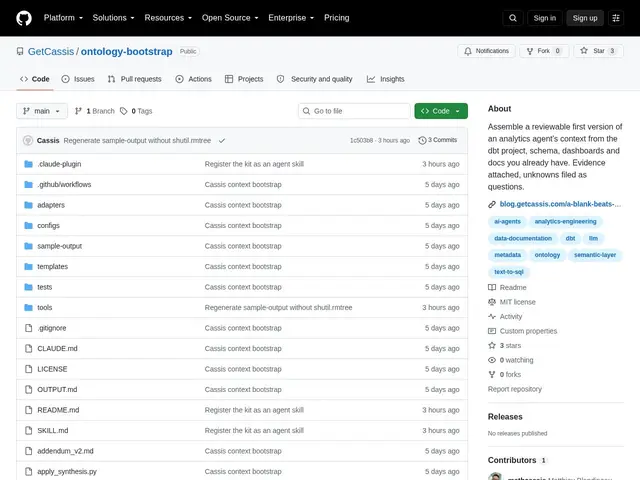
Description
AI agents that answer business questions from your data are only as good as their understanding of what your tables and columns actually mean — and most companies have never written that down anywhere a machine (or a new hire) could read it. Cassis Context Bootstrap goes through your existing dbt project, schemas, dashboards, and query history to reconstruct that missing map automatically, instead of asking someone to document it by hand.
Cassis Context Bootstrap is a free, open-source (MIT) tool that processes dbt projects, database schemas, dashboards, and query logs to generate a structured ontology — domains, tables, columns, metrics, and join relationships — for use by AI-driven analytics agents. It runs entirely locally with no external API calls or telemetry, tracks evidence-based provenance for every claim it makes about your data (so you can verify where a definition came from), and goes through a four-checkpoint review process covering scope, domain hierarchy, metrics, and blocking questions before finalizing output. It integrates with dbt, exporting to schema.yml, and can automatically flag defects or inconsistencies it finds by corroborating metrics across dashboards and query logs.
💬 Our review
The short version: Cassis Context Bootstrap solves a real, specific problem — AI analytics agents need documented data context to be trustworthy, and almost no company has that documentation in a machine-readable form — and it does it for free, running entirely on your own infrastructure.
General data catalog tools like Atlan or Select Star also document schemas and lineage, but they're commercial, cloud-hosted products aimed at human data discovery, not specifically at bootstrapping context for an AI agent, and they typically require sending metadata to a third-party service. Cassis' local-only execution with zero external calls or telemetry is a meaningful differentiator for teams with any data-sensitivity concerns. Its dbt-native integration and evidence-based provenance tracking (showing where each claim about your data came from) address the real failure mode of hand-written documentation, which drifts out of date silently. As an early-stage open-source project, the honest caveat is unproven maturity at scale — a four-checkpoint review process suggests it's still designed for a human to validate its output before trusting it fully, which is the right posture for something feeding an AI agent's understanding of your business data.
💰 Pricing
📊 Global score
🤖 AI-enriched data
Outil open source gratuit (licence MIT), exécution locale
Pros
Gratuit et open source (MIT)
Exécution 100% locale, aucun appel API externe ni télémétrie
Traçabilité des preuves pour chaque affirmation sur les données
Intégration native dbt avec export schema.yml
Cons
Projet jeune (3 commits sur main au moment de l'analyse), maturité non éprouvée
Processus de revue à 4 points suggère une validation humaine encore nécessaire
Moins de fonctionnalités de découverte que les catalogues commerciaux comme Atlan