Syncle
Open-source self-hosted tool for real-time data replication across multiple database engines (PostgreSQL, MySQL, MongoDB, Redis, SQLite, MariaDB). Eliminates need for Kafka or Debezium with lightweight synchronization via CDC, polling, or backfill.
🔗 Visit Syncle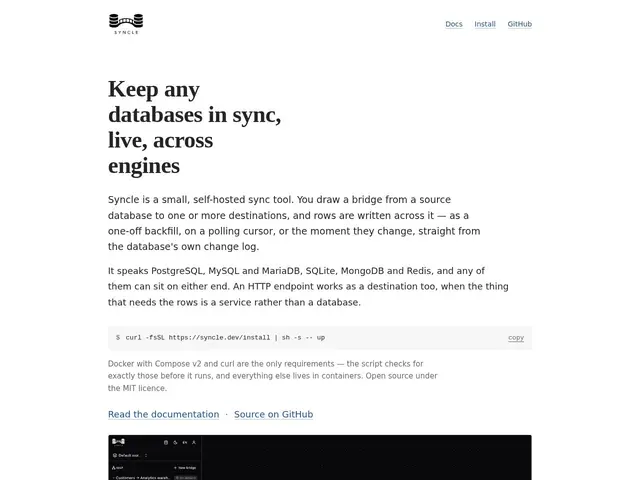
Description
If your company keeps customer data in one type of database and your analytics tool needs it in another, you normally either write custom scripts to copy it over or pay for an expensive enterprise pipeline like Kafka. Syncle is a free, self-hosted tool built to do that copying job — reliably, across almost any combination of databases — without the operational weight of running a full streaming platform.
Syncle is an open-source (MIT), self-hosted tool for real-time and batch data replication across PostgreSQL, MySQL, MongoDB, Redis, SQLite, and MariaDB, in any direction. It supports CDC (change data capture), polling, and backfill sync modes, writes idempotent upserts to avoid duplicate rows, includes a built-in database workbench for browsing and querying tables, generates ER diagrams, and encrypts stored connection credentials with AES-256-GCM. It deploys via Docker Compose with bundled PostgreSQL and Redis.
💬 Our review
The short version: Syncle solves a real, common problem — keeping two different databases in sync — without forcing you to stand up Kafka or Debezium just to do it.
Its differentiator is breadth and simplicity combined: heterogeneous replication across six database engines with multiple sync strategies (CDC, polling, backfill) in one lightweight, self-hosted Docker package, versus the operational overhead of a full Kafka/Debezium deployment or the recurring cost of a managed service like Airbyte. The honest limitation is that it's built for a single operator or small team, not a multi-user departmental data platform — there's no managed hosting option, and you're on the hook for your own Docker and backup discipline. If you're a solo developer or small team that needs two or three databases kept in sync without enterprise infrastructure, Syncle is a genuinely good fit; if you need multi-tenant governance or a managed SLA, look at Airbyte or a proper streaming platform instead.
💰 Pricing
📊 Global score
🤖 AI-enriched data
Gratuit, licence MIT, aucun frais de cloud ou d'hébergement — auto-hébergé via Docker Compose.
Pros
Totalement gratuit et open source, sans restriction de licence
Alternative légère aux solutions d'entreprise comme Kafka ou Debezium
Prend en charge des combinaisons hétérogènes de bases de données dans les deux sens
Auto-hébergé, aucune donnée envoyée à des tiers
Stockage des identifiants chiffré pour la sécurité
Cons
Conçu pour un opérateur unique, pas pour des espaces de travail multi-utilisateurs
Limité au déploiement auto-hébergé via Docker
Écosystème et communauté plus restreints que Kafka
Aucune offre de service managé
Nécessite Docker et des bases DevOps pour la mise en place