Kiso
A publishing engine that transforms Open Knowledge Format (OKF) bundles into static websites for humans and exposes them to AI agents via Model Context Protocol (MCP). Includes both CLI tools and MCP server for knowledge distribution and automated CI/CD i
🔗 Visit Kiso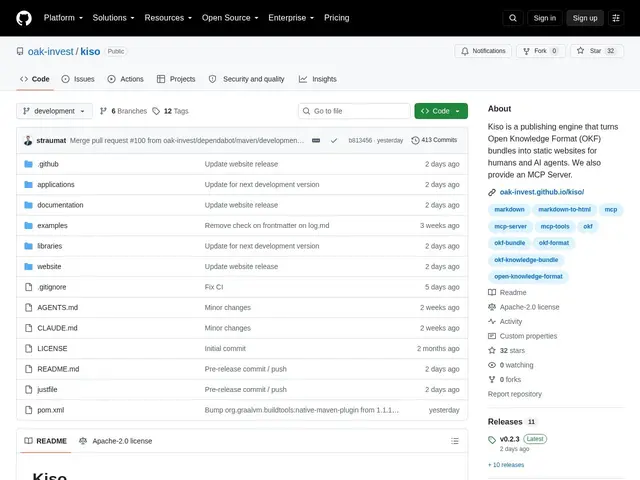
Description
Imagine you've written a detailed set of internal documentation — a wiki, a set of guides — and now you want both your human colleagues AND the AI assistant they use every day to be able to read and search through it, without maintaining two separate copies. That's the gap Kiso closes: it takes one source of knowledge and turns it into both a normal website for people and a live connection AI agents can query directly.
Kiso is a Java-based open-source publishing engine that compiles Open Knowledge Format (OKF) bundles into static websites (HTML, Markdown, metadata, sitemap.xml, llms.txt) via its kiso-cli tool, and simultaneously exposes that same knowledge base to AI applications through a bundled MCP (Model Context Protocol) server with search and retrieval tools. It integrates with GitHub Actions for automated deployment on every content update, supports DaisyUI theming, and requires no paid tier — it's Apache-2.0 licensed and fully self-hostable.
💬 Our review
The short version: Kiso is a clever, timely idea — one knowledge base that serves both your team's browser tabs and their AI agents — but it's early enough that you're adopting a young open-source project, not a mature platform.
Its real differentiator against Docusaurus or MkDocs is the built-in MCP server: instead of just publishing readable pages, it makes the same content queryable by Claude, Cursor, or any MCP-compatible agent out of the box, which none of the established static-site generators do natively. That said, it demands buy-in to the Open Knowledge Format standard and a Java toolchain, which is a real switching cost for teams already comfortable with Markdown-based docs tools, and the ecosystem (templates, plugins, community answers) is a fraction of what Docusaurus has built over years. If you're already committed to exposing internal docs to AI agents via MCP, Kiso saves you from building that bridge yourself; if you just need a documentation site, Docusaurus or MkDocs remain the safer, better-supported choice.
💰 Pricing
📊 Global score
🤖 AI-enriched data
Gratuit et open source (licence Apache-2.0), aucune version commerciale, auto-hébergeable sur n'importe quel serveur.
Pros
Source de connaissance unique servant à la fois les humains et les agents IA via le standard MCP
Workflow simple en CLI avec intégration GitHub Actions pour l'automatisation
Open source et entièrement auto-hébergeable, aucun verrouillage fournisseur
Sites générés statiques, performants et optimisés SEO
Cons
Nécessite de comprendre le standard Open Knowledge Format (OKF), courbe d'apprentissage
Écosystème limité comparé à des outils établis comme Docusaurus
Base Java, configuration additionnelle pour les équipes sans infrastructure Java
Communauté plus restreinte, moins de templates et d'intégrations disponibles