Booth
A lightweight checkpoint library for LLM outputs that validates, evaluates confidence, and gates responses with built-in ambiguity detection and reconsideration mechanisms.
🔗 Visit Booth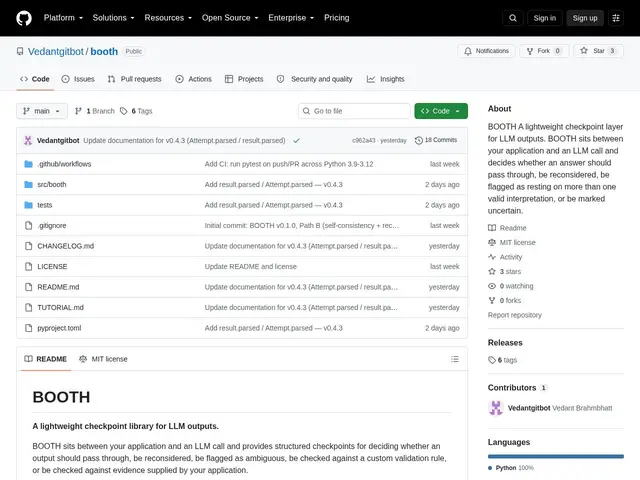
Description
When an AI model gives you an answer, how confident should you be that it's actually right — and what should happen if it isn't? Booth is a small library that sits between your app and an LLM's output, checking the confidence of each answer, catching ambiguous questions, and automatically retrying when the model seems unsure, instead of just passing along whatever the model said.
Booth is a lightweight, MIT-licensed Python library (installed via pip install boothpy) that validates and gates LLM outputs. It applies configurable confidence thresholds, detects ambiguous multi-interpretation questions, retries low-confidence responses, distinguishes formatting errors from substantive parse failures, supports custom validator functions and evidence comparison, and returns structured statuses (VERIFIED, REPAIRED, AMBIGUOUS, UNCERTAIN, BLOCKED) through both sync and async APIs.
💬 Our review
The short version: Booth is a small, focused tool for a real problem — knowing when to trust an LLM's answer — but it's early enough (3 GitHub stars at review time) that you're an early adopter, not a safe default choice yet.
Against LangChain's output parsers or Guardrails AI, Booth's differentiator is its provider-agnostic, dependency-light design and its structured result categories that distinguish "the model was ambiguous" from "the format was wrong" from "we're just not confident" — a more nuanced failure taxonomy than most guardrail libraries offer. The honest downside is maturity: minimal community adoption, no visible production case studies, and a Python-only scope, which means you're betting on a library with almost no track record. If you want fine-grained control over how uncertain LLM outputs get handled and don't mind being an early adopter, Booth is worth trying in a Python stack; if you need a proven, widely-used solution today, Guardrails AI or LangChain's built-in parsers have more real-world mileage.
💰 Pricing
📊 Global score
🤖 AI-enriched data
Gratuit, licence MIT, distribué via pip install boothpy.
Pros
Agnostique au fournisseur, fonctionne avec n'importe quel LLM sans verrouillage
Léger, peu de dépendances, intégration facile dans les systèmes existants
Gestion d'erreurs complète avec des catégories de statut distinctes
API synchrone et asynchrone pour plus de flexibilité
Cons
Projet en phase précoce, adoption communautaire minime (3 étoiles, 0 fork)
Peu d'exemples d'usage réel ou d'études de cas en production
Petite équipe de développement, résolution des problèmes potentiellement lente
Réservé à Python, ne convient pas aux autres stacks applicatifs