D5s
D5s is a collaborative AI agent workspace that enables teams to work alongside governed AI agents with data isolation and sandbox execution. It supports 280+ business tool connectors and flexible model selection (OpenAI, Anthropic, Mistral) across any clo
🔗 Visit D5s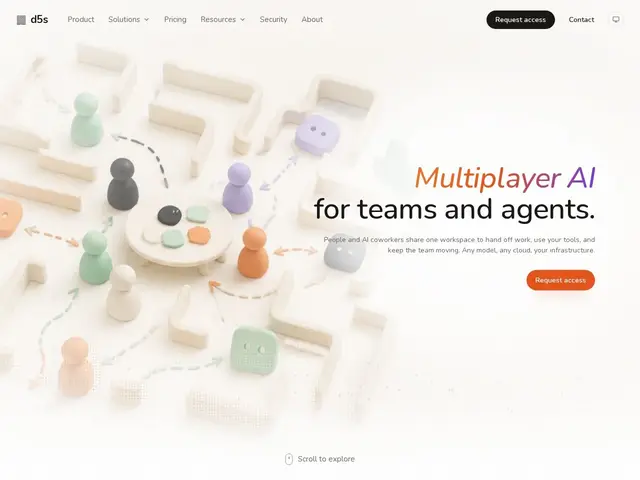
Description
Most "AI agent" tools are built for individuals — one person, one chatbot. D5s is built for something different: a shared workspace where an entire team and a fleet of AI agents work side by side on real business tasks, with permissions, audit logs, and approval steps so a regulated company (a law firm, a hospital system, a government agency) can actually trust what the agents are doing.
D5s is a governed, collaborative AI agent workspace supporting 280+ business tool connectors (Slack, Gmail, Notion, GitHub, HubSpot, and more), flexible model selection across OpenAI, Anthropic, and Mistral (bring-your-own-keys), and deployment on AWS, self-hosted VPC, on-premise, or air-gapped infrastructure. It provides agent sandboxing with scoped data access, role-based permissions, full action logging, audit trails, and approval workflows for real-time team collaboration on agent-assisted work.
💬 Our review
The short version: D5s is aimed squarely at organizations that can't just let an AI agent loose on their systems — it's the governance and audit layer that regulated industries need before they'll trust agents with real work.
Against lighter automation tools like n8n or Make, D5s's differentiator is enterprise-grade governance: sandboxed agent execution, role-based permissions, complete audit logging, and deployment options down to air-gapped environments, aimed at legal, finance, life sciences, and government use cases where "the agent did something and we don't know why" is not an acceptable answer. The tradeoff is exactly what you'd expect from an enterprise governance tool: pricing requires talking to sales, there's no visible free tier, and the multi-agent workflow setup has a real learning curve — none of which matters if you're a two-person startup that just wants quick automation. If you're in a regulated industry and need auditable, permissioned AI agent collaboration, D5s is worth the sales conversation; for lightweight internal automation without compliance requirements, n8n or Make will get you there faster and cheaper.
💰 Pricing
📊 Global score
🤖 AI-enriched data
Tarification personnalisée sur demande, aucune offre en libre-service publique.
Pros
Aucun verrouillage fournisseur, prise en charge du bring-your-own-model
Couverture d'outils complète via plus de 280 connecteurs
Sécurité de niveau entreprise avec sandboxing et gouvernance
Options de déploiement flexibles, y compris air-gapped
Conçu pour les industries réglementées avec journalisation d'audit intégrée
Cons
Tarification nécessitant un contact commercial
Courbe d'apprentissage abrupte pour les workflows multi-agents complexes
Peu d'informations publiques sur une offre gratuite ou un essai
Configuration technique requise pour les options auto-hébergées
Charge de gouvernance potentiellement excessive pour les petites équipes