Warpdrive
Free, open-source, self-hosted CRM for business-development teams — pipeline, deals, contacts, and two-way Gmail sync, with no per-seat fees.
🔗 Visit Warpdrive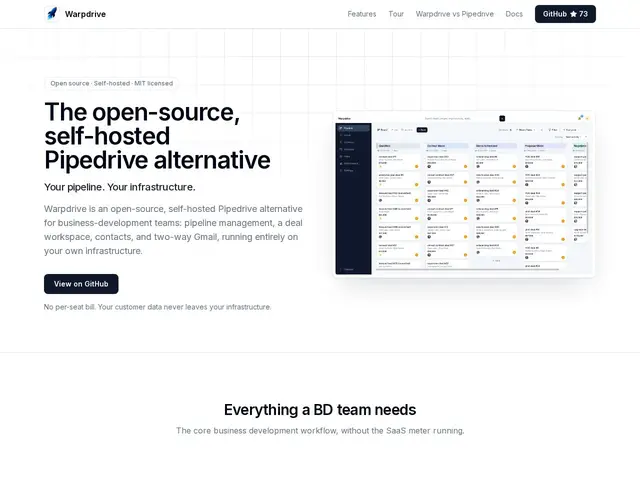
Description
Most CRMs charge per person, per month, forever — so the bill keeps climbing as your sales team grows, even though the software itself doesn't cost more to run. Warpdrive flips that: you run it yourself on your own server, and once it's set up, adding another teammate costs nothing extra.
Warpdrive is an open-source (MIT license), self-hosted CRM built specifically for business-development and sales teams: a Kanban-style pipeline board, deal workspaces, contact management, two-way Gmail integration with tracking and templates, and role-based permissions for the team. It deliberately leaves out heavier features like invoicing, forecasting, and workflow automation to stay focused on the core pipeline-and-contacts job. It's built on a modern stack — Next.js, React, TypeScript, PostgreSQL — and ships as a single Docker Compose deployment that bundles the app, a WebSocket server for real-time updates, a background worker, the database, MinIO storage, and a Caddy reverse proxy. It's still small (73 GitHub stars), but actively developed.
💬 Our review
The short version: Warpdrive is an honest, no-frills open-source Pipedrive alternative — if your team just needs a pipeline board, contacts, and Gmail sync without a per-seat bill, it does that job well and costs nothing but hosting.
Against Pipedrive or HubSpot, the tradeoff is obvious: those are polished, feature-rich, and require zero setup, but bill per seat every month, which adds up fast for a growing sales team. Warpdrive asks you to run your own Docker Compose stack instead, which means real setup and maintenance work, but after that the marginal cost of adding teammates is zero. Compared to Twenty, another open-source CRM competing in the same space, Warpdrive is narrower in scope — it explicitly skips invoicing, forecasting, and automation to stay simple, so teams that need those will outgrow it. At 73 GitHub stars it's an early, small project, so expect fewer integrations and less community support than mature alternatives. For a lean sales team with the technical capacity to self-host and no need for advanced automation, it's a genuinely cost-effective choice; for anything more complex, a hosted SaaS CRM will save you the ops burden.
💰 Pricing
📊 Global score
🤖 AI-enriched data
Licence MIT, gratuit en auto-hébergement, aucun abonnement ni facturation par utilisateur ; seuls les coûts d'infrastructure s'appliquent
Pros
entièrement gratuit et open source (licence MIT)
auto-hébergé, garantit la confidentialité et la souveraineté des données
aucune facturation par utilisateur, un seul déploiement Docker Compose pour toute l'équipe
intégration Gmail bidirectionnelle avec suivi et modèles
tableau pipeline Kanban avec glisser-déposer
Cons
petite communauté (73 étoiles GitHub), intégrations tierces limitées
nécessite l'auto-hébergement : gestion de l'infrastructure, mises à jour, sauvegardes
exclut volontairement facturation, prévisions et automatisation de workflow
interface moins aboutie que les CRM SaaS matures