Synara
Free desktop app that runs multiple AI coding agents — Claude, Codex, Cursor and more — in parallel, each in its own isolated git worktree so they never step on each other.
🔗 Visit Synara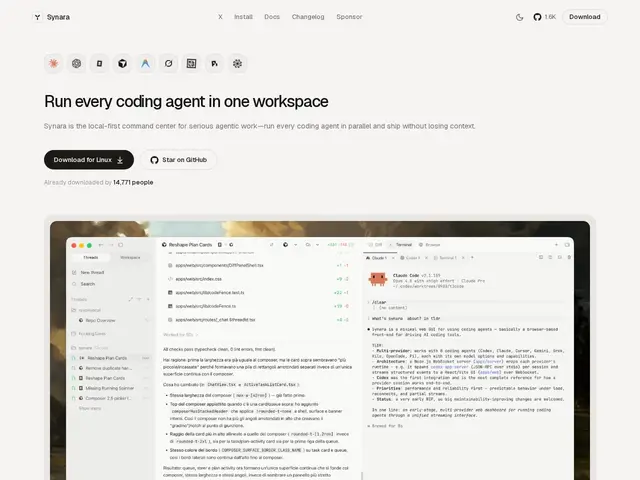
Description
If you've tried running two AI coding assistants on the same project at once, you've probably run into the problem of them editing the same files and stepping on each other's changes. Synara solves that by giving each agent its own isolated copy of the repo to work in, then letting you review and merge the results side by side.
Synara is a free, open-source (MIT license) desktop application built with TypeScript, React, and the Bun runtime, that runs up to eight or more AI coding agents in parallel — Claude, Codex, OpenCode, Cursor, Antigravity, Grok Build, Kilo Code, Pi, and Factory Droid are all supported — each inside its own isolated git worktree. It includes an integrated terminal, browser, and full git workflow tooling (commit, push, and pull-request creation), plus 'provider handoffs' that let you transfer an in-progress task from one agent to another mid-conversation. It runs entirely local-first, with no cloud proxy or Synara-hosted backend — you authenticate directly with each provider's own account. The project has 1.6k GitHub stars and active development (3,000+ commits, 246 forks).
💬 Our review
The short version: Synara is a genuinely useful free tool if you regularly compare or combine multiple AI coding agents — the isolated-worktree design solves a real collision problem, and the local-first, no-lock-in architecture is a meaningful advantage.
Against Jean, a similarly-positioned tool for running multiple agents in isolated worktrees, Synara differentiates on breadth — support for eight-plus providers including less common ones like Kilo Code and Factory Droid, plus mid-task provider handoffs that let you switch agents without starting over. Against just using Cursor or GitHub Copilot directly inside your existing editor, Synara trades a simpler single-agent workflow for real multi-agent flexibility, at the cost of needing separate API keys or accounts for each provider you want to use. It's desktop-only with no cloud/web option, so remote or lightweight setups aren't its target use case. For developers actively experimenting with or comparing multiple AI coding agents, it's a well-built free option; if you've already settled on one agent and don't need to run others in parallel, the added complexity isn't worth it.
💰 Pricing
📊 Global score
🤖 AI-enriched data
Entièrement gratuit et open source (licence MIT), aucun palier d'abonnement ni service hébergé par Synara ; authentification directe avec le compte de chaque fournisseur IA
Pros
entièrement gratuit et open source, sans dépendance fournisseur
support de 8+ agents IA en simultané (Claude, Codex, OpenCode, Cursor, Antigravity, Grok Build, Kilo Code, Pi, Factory Droid)
worktrees git isolés empêchant les agents de s'écraser mutuellement
architecture local-first, aucun proxy cloud ni dépendance distante
transfert de tâche entre agents en cours de conversation (provider handoffs)
Cons
nécessite de gérer plusieurs clés API/comptes selon les fournisseurs IA utilisés
projet open source relativement jeune (1.6k étoiles GitHub)
courbe d'apprentissage pour les développeurs non familiers du multi-agent
solution desktop uniquement, pas d'alternative cloud ou web