Tabularis
Free, open-source desktop SQL client for Postgres, MySQL, SQLite and 19+ other databases, with a built-in server that lets AI coding agents query your schema safely.
🔗 Visit Tabularis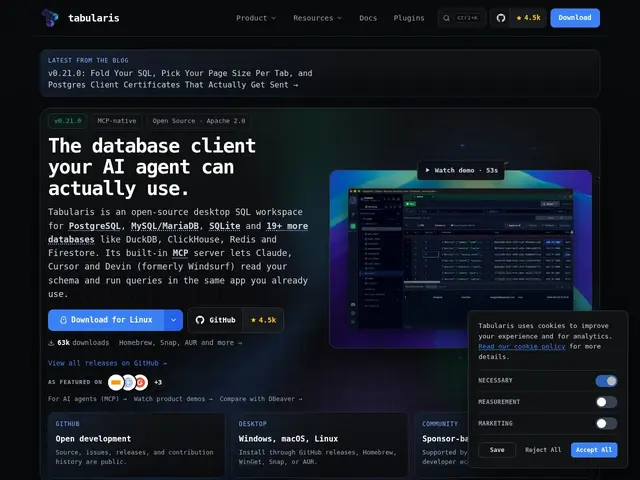
Description
Database GUI tools have existed for decades, but most of them were built before AI coding assistants existed — so when your AI agent needs to understand your database schema, it either can't, or you have to paste table definitions into a chat window by hand. Tabularis is a database client built for that gap: it opens up your schema to AI agents through a proper, controlled connection instead of manual copy-pasting.
Tabularis is a free, open-source (Apache 2.0) desktop application, built with Tauri for a small cross-platform footprint on Windows, macOS, and Linux. It connects to PostgreSQL, MySQL/MariaDB, SQLite, DuckDB, ClickHouse, Redis, Firestore, and more than a dozen other databases, and includes a built-in MCP (Model Context Protocol) server so tools like Claude and Cursor can read schema and run queries in a controlled, auditable way. Beyond the AI angle, it offers SQL notebooks that combine queries, markdown, charts, and variables in one workspace, a visual query builder, visual EXPLAIN plans for performance tuning, SSH tunneling, and a JSON-RPC plugin system. It's actively developed, with 4.5k+ GitHub stars and nearly 2,000 commits.
💬 Our review
The short version: Tabularis is a legitimately capable free database client with a real differentiator — native MCP support for AI agents — that established tools like DBeaver and TablePlus don't build in the same way.
Against DBeaver, the long-standing free/open-source default, Tabularis is younger and has a smaller plugin ecosystem, but it's purpose-built around the reality that developers now query databases through AI agents as often as by hand — its MCP server means an agent can inspect your schema and run queries without you manually feeding it context. Against TablePlus, a slick paid native client, Tabularis wins on price (completely free vs. a one-time license fee) but is less polished in places given its younger codebase. If you're not using AI agents in your database workflow, DBeaver's maturity and huge plugin catalog still make it the safer default; but if schema-aware AI querying is part of your daily workflow, Tabularis is worth switching to specifically for that.
💰 Pricing
📊 Global score
🤖 AI-enriched data
Entièrement gratuit, open source sous licence Apache 2.0, aucun palier payant
Pros
gratuit et open source avec développement actif (4.5k étoiles GitHub, ~1900 commits)
serveur MCP intégré permettant aux agents IA de lire le schéma et exécuter des requêtes en sécurité
support de 20+ bases : PostgreSQL, MySQL/MariaDB, SQLite, DuckDB, ClickHouse, Redis, Firestore, etc.
SQL Notebooks combinant SQL, markdown, graphiques et variables
constructeur de requêtes visuel et EXPLAIN visuel pour l'optimisation
Cons
outil plus récent, écosystème plus restreint que DBeaver
système de plugins moins développé que chez les concurrents établis
communauté et intégrations tierces encore limitées