OpenSERP
Open-source API that queries Google, Bing, Yandex, Baidu, DuckDuckGo, and Ecosia through one unified endpoint — self-host for free or use the pay-per-query cloud.
🔗 Visit OpenSERP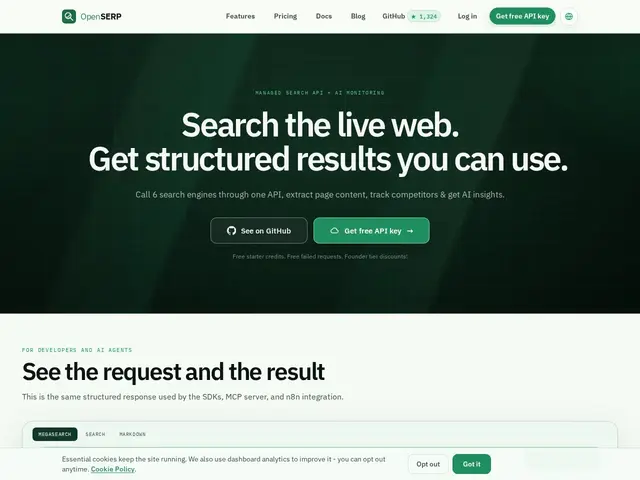
Description
If you've ever needed to pull search-engine results programmatically — for SEO tracking, competitive research, or feeding an AI agent real-time web data — you've probably run into paid APIs charging per search with no way to see or control what's happening under the hood. OpenSERP is the alternative: the code is open, you can run it yourself for nothing, or pay a small fee to a managed version that uses the exact same API.
OpenSERP is a Go-based, MIT-licensed search-results API that unifies six engines — Google, Bing, Yandex, Baidu, DuckDuckGo, and Ecosia — behind one REST interface, returning structured JSON with ranks, titles, URLs, snippets, and richer SERP features like AI summaries, answer boxes, and people-also-ask blocks. It ships as a Docker container or a Go binary for self-hosting, or you can use the managed cloud version at roughly $0.0078 per successful query (with 60 free starter credits) if you don't want to run your own infrastructure. It includes official JavaScript/TypeScript and Python SDKs, an MCP server for AI agent integration, and an n8n community node, and is actively maintained with 1.3k+ GitHub stars.
💬 Our review
The short version: OpenSERP is a legitimately strong pick for anyone who needs multi-engine search data without vendor lock-in — the self-hosted option is genuinely free, and the managed cloud pricing undercuts most commercial SERP APIs.
Against SerpAPI or Serper.dev, which are polished but closed and priced per plan tier, OpenSERP's $0.0078-per-query pay-as-you-go cloud pricing is notably cheaper for low-to-medium volume use, and the self-hosted option removes the cost entirely if you have the infrastructure to run it. Against Bright Data or Oxylabs, which target large-scale scraping operations with proxy networks and enterprise support, OpenSERP is a leaner, more developer-focused tool — six engines through one clean API, not a full scraping platform. The catch is community size: at 1.3k GitHub stars it's smaller than the established commercial players, so documentation for advanced use cases and third-party integrations are still catching up. For SEO tooling, competitive research, or feeding structured search data to an AI agent, it's a strong default; for high-volume enterprise scraping with dedicated support contracts, the bigger commercial players may still be the safer bet.
💰 Pricing
📊 Global score
🤖 AI-enriched data
Auto-hébergé gratuit à vie (licence MIT) ; cloud managé au paiement à l'usage à 0,0078 $/requête, 60 crédits gratuits pour démarrer
Pros
option auto-hébergée totalement gratuite, sans dépendance fournisseur, licence MIT
couverture de 6 moteurs de recherche via une API unique
tarification cloud très basse (0,0078 $/requête) face à la concurrence
SDK officiels JS/TS et Python, serveur MCP pour agents IA, nœud n8n
sortie JSON structurée avec extraction de fonctionnalités SERP riches
Cons
communauté et écosystème plus restreints que SerpAPI ou Serper.dev
l'auto-hébergement demande des compétences en déploiement
limitation de débit possible sur l'infrastructure cloud partagée
documentation encore perfectible pour les cas d'usage avancés