Omnigent
Open-source layer that sits above Claude Code, Codex, Cursor and other AI coding agents to add policy enforcement, sandboxing, and shared collaborative sessions.
🔗 Visit Omnigent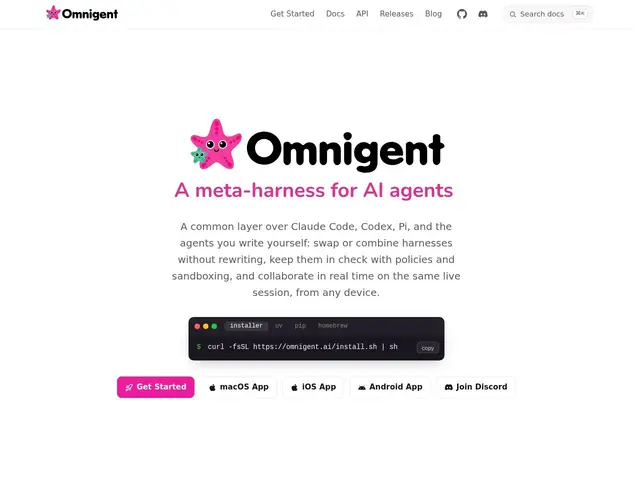
Description
If you use more than one AI coding assistant, you've probably noticed each one has its own rules, its own way of handling permissions, and no shared memory of what the others just did. Omnigent tries to fix that by sitting above all of them as a common control layer — one place to say what an agent is and isn't allowed to touch, no matter which underlying AI is doing the work.
Omnigent is an open-source (Apache 2.0) orchestration layer for AI coding agents: it wraps tools like Claude Code, Codex, Cursor, and Pi behind a swappable interface, adds sandboxing with filesystem and network restrictions, enforces spend caps and model-routing policies, and supports real-time collaborative sessions where a team can share an agent's history and state. It integrates with sandbox providers such as Modal, Daytona, E2B, Kubernetes, and CoreWeave, and is accessible from CLI, web, desktop, iOS, and Android. The project has built a substantial following (9.5k GitHub stars, 3,000+ commits) despite still being in alpha.
💬 Our review
The short version: Omnigent is a promising governance layer for teams running multiple AI coding agents, but it's still alpha software — the value proposition (policy enforcement, sandboxing, agent portability) is real, the production-readiness isn't there yet.
It overlaps conceptually with tools like Jean and Synara, which also let developers run multiple agents in parallel across isolated environments — but those focus on the developer's own multi-agent workflow, while Omnigent is explicitly about organizational control: spend caps, sandboxing policy, and audit-friendly collaborative sessions for a team, not just an individual. Compared to building this kind of governance yourself on top of raw agent CLIs, Omnigent saves real engineering time if you need it now. Compared to just using Claude Code or Cursor directly without an orchestration layer, it adds meaningful safety guarantees at the cost of extra setup complexity and self-hosting effort — there's no managed cloud version yet. For teams that are already worried about what their AI agents can touch and want that policy layer decoupled from any single vendor's agent, it's worth trying despite the alpha label; for solo developers just picking one agent and using it directly, it's more infrastructure than you need.
💰 Pricing
📊 Global score
🤖 AI-enriched data
Licence Apache 2.0, entièrement open source, auto-hébergé ; aucune offre commerciale/managée publiée
Pros
orchestration multi-agents avec harnais interchangeables (Claude Code, Codex, Cursor, Pi)
sandboxing intégré avec restrictions fichiers et réseau
politiques contextuelles avec plafonds de dépense et routage de modèle
sessions collaboratives en temps réel avec historique partagé
accès multi-plateforme (CLI, web, desktop, iOS, Android)
Cons
encore en alpha, pas prêt pour la production
nécessite un auto-hébergement ou un déploiement personnalisé
écosystème commercial et support limités pour l'instant