GitComet
Rust-built Git GUI for Linux, macOS and Windows, designed to stay responsive on very large repositories that make older Git clients stutter.
🔗 Visit GitComet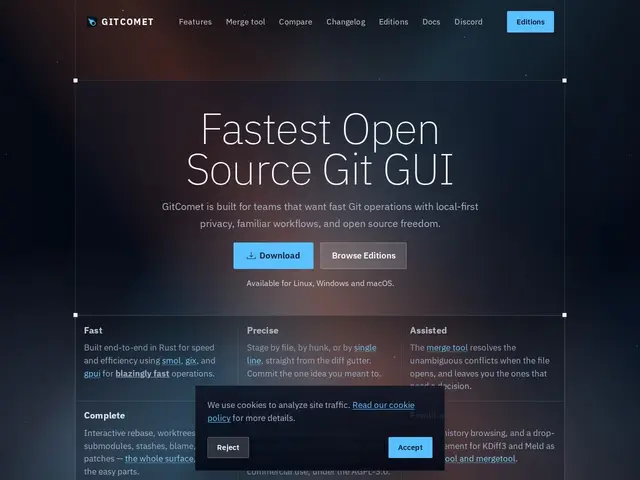
Description
Git GUIs are old software — many of the popular ones were built over a decade ago, before repositories routinely reached hundreds of thousands of commits. When those tools try to diff, merge, or browse history on a truly massive codebase, they can noticeably slow down. GitComet was built specifically to not do that.
GitComet is a Git GUI written in Rust using the GPUI framework, built by AutoExplore Oy for Linux, macOS, and Windows (x86-64 and ARM64). It covers the full workflow — hunk/line-level staging, git worktrees, branching, merge conflict resolution, interactive rebase, and multi-repo browsing — with a built-in editor supporting syntax highlighting for 44+ languages. The open-source edition is free forever under AGPL-3.0; a Professional Edition with Claude/Codex integrations and test-coverage workflows is planned as a €20 lifetime purchase, currently in an early-adopter waitlist. At 783 GitHub stars, it's a younger project with an active Discord community and OpenCollective sponsorship.
💬 Our review
The short version: GitComet is a technically credible, genuinely fast Git client aimed squarely at developers working in large repositories, but it's early — the Professional Edition isn't shipped yet, and it's competing against Git GUIs with a decade-plus head start.
Against GitKraken or Tower, which are mature, feature-rich, and subscription-priced, GitComet's free AGPL-3.0 core covers the essentials (staging, worktrees, merge, rebase, multi-repo) without a recurring fee, and its Rust/GPUI foundation is specifically built for responsiveness on large repos where older Electron-based tools can lag. Against Sourcetree (free but Atlassian-maintained, no longer actively evolving) or Fork (a solid lightweight paid option), GitComet is newer and smaller — 783 stars is modest next to GitKraken's install base — so expect fewer tutorials, less community troubleshooting, and a Professional Edition that's still a waitlist promise rather than a shipped product. If raw performance on a huge repo is your actual pain point and you're comfortable with a younger open-source tool, it's worth trying; if you want a mature, fully-featured GUI today, GitKraken or Fork remain the safer choice.
💰 Pricing
📊 Global score
🤖 AI-enriched data
Édition open source gratuite à vie (AGPL-3.0) ; édition Professionnelle prévue à 20 € en achat unique à vie (liste d'attente early-adopter)
Pros
open source (AGPL-3.0) avec transparence totale du code
performance optimisée pour les dépôts volumineux
fonctionnalités complètes : staging par ligne/hunk, worktrees, outils de fusion, rebase interactif
multi-plateforme (Linux, macOS, Windows ; x86-64 et ARM64)
éditeur intégré avec coloration syntaxique pour 44+ langages
Cons
licence AGPL-3.0 potentiellement restrictive pour une redistribution commerciale
édition Professionnelle encore en liste d'attente, disponibilité incertaine
projet jeune (783 étoiles GitHub) face à des concurrents établis comme GitKraken
intégrations entreprise limitées tant que l'édition Pro n'est pas sortie