Tinysandbox
A containerless, ultra-lightweight sandbox for AI agents, bundling a bash-like shell, Rust-native coreutils, and a sandboxed JavaScript runtime in a single crate.
🔗 Visit Tinysandbox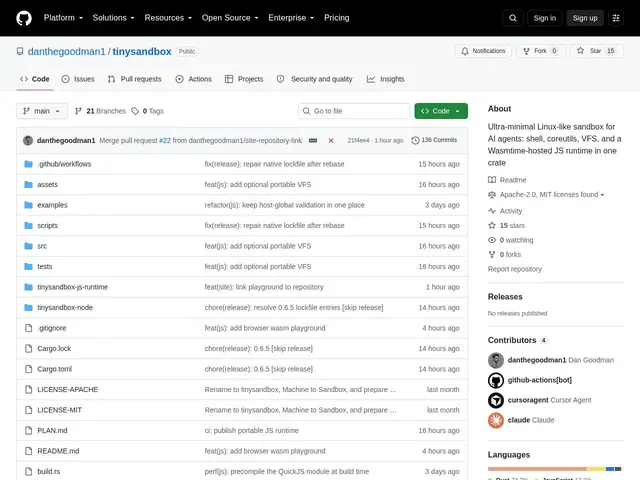
Description
If you're building an AI agent that needs to run shell commands or JavaScript safely, spinning up a Docker container for every command is slow and heavy — Tinysandbox skips that step entirely, running commands directly against an in-memory virtual filesystem instead.
Tinysandbox is a Rust crate that bundles a POSIX-compatible shell subset (pipes, redirects, variables), native Rust implementations of common coreutils (cat, grep, sort, wc, jq, and more), and a sandboxed JavaScript runtime built on QuickJS compiled to WebAssembly via Wasmtime — all without requiring containers or virtual machines. It boots instantly with a kilobyte-scale idle memory footprint, enforces wall-clock timeouts, memory caps, and output bounds on every execution, and supports pluggable virtual filesystem backends (in-memory, local directory, or S3). The JavaScript layer is also available standalone as the @tinysandbox/js-runtime npm package, which creates fresh QuickJS state per invocation for Node.js and browser environments. It's free and dual-licensed under MIT or Apache-2.0.
💬 Our review
The short version: Tinysandbox is a clever, genuinely lightweight alternative to spinning up containers for agent-executed shell and JS commands, but with only 15 GitHub stars and zero forks, it's an early solo project you should pilot carefully rather than drop into production today.
Compared to heavier sandboxing options like Firecracker microVMs, gVisor, or hosted services like E2B, Tinysandbox's appeal is its footprint: no container runtime, no VM boot time, just a Rust crate that runs POSIX-ish shell commands and sandboxed JavaScript directly, with hard resource limits baked in. That makes it attractive for teams building their own AI coding agents who don't want the latency or ops overhead of Docker-per-command. The tradeoffs are real, though — it's unproven at scale, the project is maintained by a single developer, and the split between the Rust crate and the separate JS-runtime npm package adds a bit of integration complexity. If you're prototyping an agent sandbox and want to avoid container overhead, it's worth a look; if you need battle-tested isolation guarantees for untrusted code in production, E2B or gVisor have more of a track record.
💰 Pricing
📊 Global score
🤖 AI-enriched data
Crate Rust + package npm gratuits, double licence MIT/Apache-2.0, aucune offre hébergée
Pros
démarrage quasi instantané, empreinte mémoire minime
aucun conteneur ni VM requis
JS sandboxé avec limites de ressources strictes
gratuit, double licence MIT/Apache-2.0
Cons
projet très jeune (15 étoiles, 0 fork)
maintenu par un seul développeur
crate Rust + package npm séparés, intégration à assembler soi-même