LiveKit Agents
Open-source framework for building real-time voice and multimodal AI agents that see, hear, and respond live.
🔗 Visit LiveKit Agents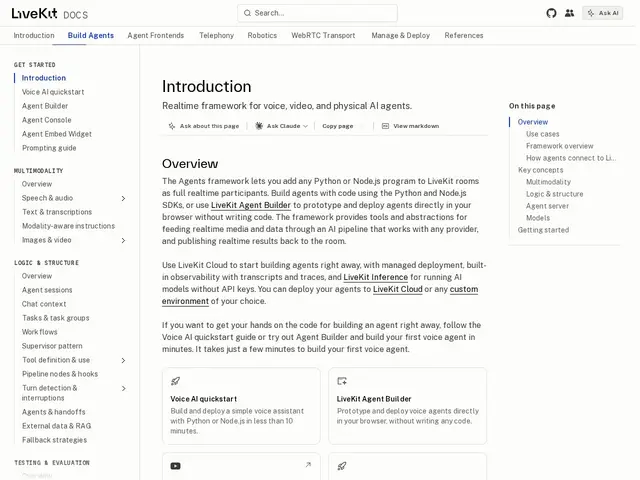
Description
Building a voice assistant that actually feels like a conversation — one that knows when to interrupt, when to wait, and doesn't lag awkwardly after you finish speaking — is a genuinely hard real-time engineering problem, not just a matter of calling a speech API. LiveKit Agents packages that hard part into a framework so developers can focus on what the agent should say, not how to stream audio without stutter.
LiveKit Agents is an open-source Python and Node.js framework for building real-time, multimodal AI agents that operate as server-side participants in a LiveKit room. It handles the plumbing — audio streaming, turn detection, interruption handling, and multi-agent handoffs — while letting developers plug in any speech-to-text, LLM, and text-to-speech provider they choose. It supports the Model Context Protocol (MCP) and is built for production deployment on Kubernetes. Typical use cases include customer service voice bots, telehealth intake, game NPCs, live translation, and voice interfaces for robotics.
💬 Our review
The short version: if you're building a voice AI product and don't want to hand-roll the real-time audio pipeline yourself, LiveKit Agents is one of the more mature open-source options, and it's free.
Against hosted platforms like Vapi or Retell AI, which trade flexibility for a faster path to a working voice bot, LiveKit Agents asks more upfront engineering effort but avoids vendor lock-in on the model providers — you choose your own STT/LLM/TTS stack rather than being tied to whatever the platform bundles. Compared to Pipecat, another open-source real-time agent framework, the two are genuinely competing options and the right choice often comes down to which one's provider integrations and community match your stack. For a team with backend engineers who can operate WebRTC infrastructure, this is a strong free option; for a non-technical founder who just wants a voice bot live this week, a hosted platform will get there faster.
💰 Pricing
📊 Global score
🤖 AI-enriched data
Open-source (Apache 2.0), gratuit ; LiveKit Cloud disponible en option avec tarification à l'usage pour l'infrastructure
Pros
gratuit et open-source (Apache 2.0)
gère la détection de tour de parole et les interruptions nativement
compatible avec n'importe quel fournisseur STT/LLM/TTS, pas de lock-in
support du Model Context Protocol (MCP)
prêt pour la production (déploiement Kubernetes)
Cons
demande plus d'ingénierie qu'une plateforme vocale clé-en-main
nécessite de gérer soi-même l'infrastructure WebRTC (ou payer LiveKit Cloud)
courbe d'apprentissage plus raide que Vapi/Retell AI