Open SAR-COP
Open-source AI system that turns public disaster information into an interactive situational-awareness dashboard within the first 72 hours.
🔗 Visit Open SAR-COP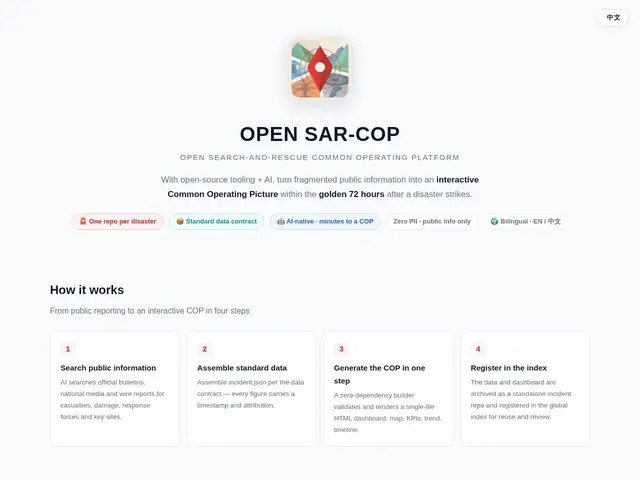
Description
When a disaster hits — an earthquake, a landslide, a flood — the first three days are the most critical for search-and-rescue and aid coordination, but the information is usually scattered across news reports, social media, and government bulletins with no single place to see the full picture. Open SAR-COP is built to fix exactly that: it automatically pulls together public information about a disaster and turns it into a single interactive map/dashboard responders can actually use.
Open SAR-COP is an open-source (MIT) project that uses AI to search public sources, assemble timestamped and attributed data about a disaster, and generate an interactive Common Operating Picture (COP) dashboard — a single-file HTML file that needs no server to run. It includes a global index tracking multiple ongoing disasters and has been demonstrated on a real case study (the 2026 Nepal Rasuwa landslide). The interface supports English and Chinese, and the project states it collects zero personally identifiable information by design.
💬 Our review
The short version: if you work in disaster response, humanitarian coordination, or you're building tooling in that space, Open SAR-COP is worth evaluating because it automates a genuinely painful manual task — assembling a coherent picture from scattered public sources — and ships as a free, no-server-required HTML dashboard you can generate and share immediately.
Compared to established platforms like Ushahidi or Sahana Eden, which are mature crisis-mapping systems with large deployments behind them, Open SAR-COP is newer and narrower in scope — it focuses specifically on AI-assisted assembly of a single-incident dashboard rather than being a full incident-management platform. For a fast, zero-infrastructure situational snapshot during the critical first 72 hours, it's a compelling free option; for long-running, multi-agency incident management, an established platform like Sahana Eden is still the more complete tool.
💰 Pricing
📊 Global score
🤖 AI-enriched data
Open source (MIT), gratuit — dashboard HTML autonome, aucune infrastructure serveur requise
Pros
automatise l'agrégation d'informations publiques dispersées en un tableau de bord unique
dashboard HTML autonome, sans serveur, facile à partager
gratuit et open source (MIT)
zéro collecte de données personnelles par conception
déjà testé sur un cas réel (glissement de terrain Rasuwa, Népal 2026)
Cons
projet plus récent et de portée plus étroite que les plateformes établies (Ushahidi, Sahana Eden)
pas conçu comme plateforme complète de gestion d'incidents multi-agences
dépend de la qualité et disponibilité des sources publiques en amont