Atlas:Face
Free, open-source desktop app that turns your notes, PDFs, and videos into a 3D linked knowledge map with built-in spaced-repetition flashcards.
🔗 Visit Atlas:Face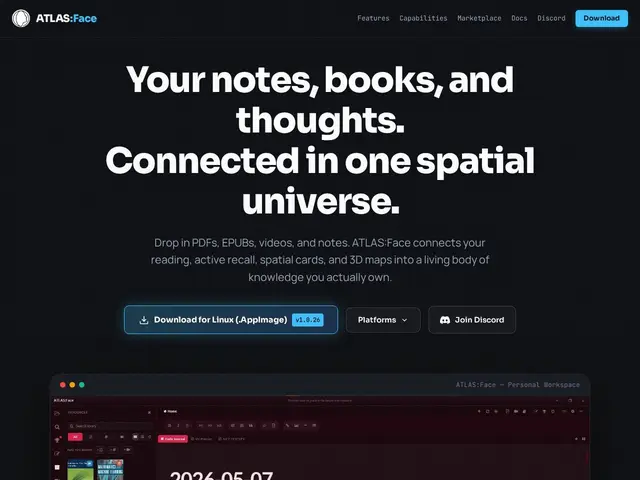
Description
Most note-taking apps give you a flat list of pages or a folder tree — fine for jotting things down, but not great for seeing how ideas connect, or for actually remembering what you studied. Atlas:Face takes a different approach: it lays your notes out as a 3D map where related ideas are visually linked, reads PDFs and e-books so you can turn any highlight into a flashcard with one click, and quizzes you on a schedule designed to make things stick in long-term memory.
Atlas:Face is a free, open-source desktop knowledge-management app (source on GitHub at Resistance-Labs-Tech/atlasface) aimed at students and researchers. Core features include a 3D "Knowledge Universe" map with bi-directional note linking, a native PDF/EPUB reader with a highlight-to-flashcard pipeline, a spaced-repetition scheduling engine, YouTube video analysis that generates real-time transcript-based quizzes, and a freeform visual canvas for sketching and handwritten notes. All data is stored locally with no cloud dependency, which also means no built-in cross-device sync.
💬 Our review
The short version: if you're the kind of learner who actually uses spaced repetition and wants your reading, note-taking, and flashcard creation in one local, free, open-source app instead of three separate subscriptions, Atlas:Face is a genuinely ambitious attempt at that — you just have to accept it's early and unpolished in places.
It's competing with a fragmented but well-established field: Obsidian (linked notes, huge plugin ecosystem, free for personal use), Anki (the gold standard for spaced repetition, free and open source), and Notion (all-purpose notes, freemium). Atlas:Face's bet is that combining PDF reading, flashcard generation, and 3D visual linking in one app removes the friction of stitching those together yourself — a real pain point for heavy readers. What you give up is Obsidian's massive plugin/community ecosystem and Anki's decades of spaced-repetition algorithm refinement; as a young open-source project, Atlas:Face's scheduling algorithm and long-term stability haven't been battle-tested the same way. Worth it if you want a single free app that reads your PDFs AND drills you on them; stick with Obsidian+Anki separately if you want each piece to be best-in-class rather than integrated. <!-- ai-generated -->
💰 Pricing
📊 Global score
🤖 AI-enriched data
Application open source gratuite, aucun palier payant
Pros
carte 3D des connaissances avec liens bidirectionnels entre notes
lecteur PDF/EPUB natif avec pipeline surlignage → flashcard
répétition espacée intégrée
analyse de vidéos YouTube avec quiz générés depuis la transcription
open source, données 100% locales, gratuit
Cons
projet jeune, pas d'écosystème de plugins comparable à Obsidian
algorithme de répétition espacée moins éprouvé que celui d'Anki
pas de synchronisation multi-appareils native (tout est local)