FreeLLMAPI
Aggregates 34 free LLM providers (635 model endpoints) behind a single OpenAI-compatible API, with smart routing and automatic failover.
🔗 Visit FreeLLMAPI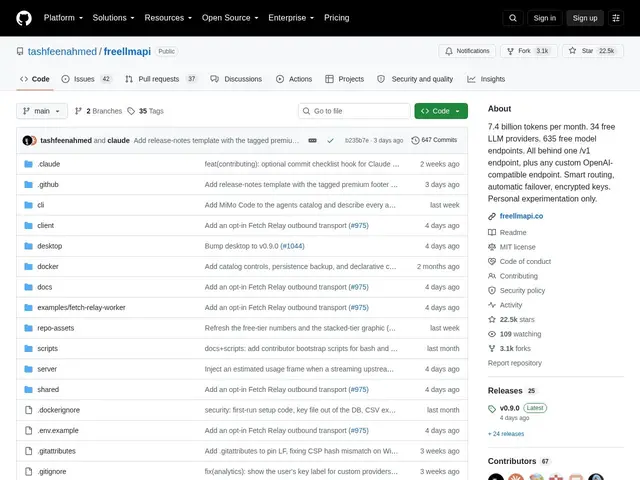
Description
Free-tier LLM access exists across dozens of providers, but each one has its own API shape, its own rate limits, and its own way of failing when you hit them — which means using free tiers seriously usually means writing (and maintaining) a pile of provider-specific fallback logic yourself. FreeLLMAPI does that consolidation work for you: one OpenAI-compatible endpoint, and it handles picking a provider, routing around rate limits, and rotating keys behind the scenes.
FreeLLMAPI aggregates 34 free LLM providers and 635 free model endpoints (about 7.4 billion tokens/month combined) behind a single /v1 API that's OpenAI-compatible, plus support for any custom OpenAI-compatible endpoint. It self-hosts via Docker on macOS, Windows, or a Raspberry Pi with a one-line install, and its router automatically fails over to the next provider when one is rate-limited, rotating keys to stay under each free-tier cap. The model catalog auto-updates from a signed feed, so new free models and quota changes land without a manual update. It supports chat, embeddings, image generation, audio, and video endpoints. It's MIT-licensed, self-hosted and free, with an optional hosted version at $19/year (or $49 lifetime) for faster catalog updates without running your own instance.
💬 Our review
The short version: if you're building something on free-tier LLM access and tired of babysitting rate limits across multiple providers, FreeLLMAPI does the aggregation and failover work for you — worth setting up for hobby projects or cost-sensitive prototypes, and the $19/year hosted option is cheap enough that skipping the self-hosting hassle is a reasonable call for most people.
OpenRouter and LiteLLM solve an adjacent problem — routing across paid model providers with a unified API — but FreeLLMAPI is specifically built around stitching together free tiers, which neither of those tools does as their core focus. Its real value is the failover logic: rather than your app breaking when one free provider rate-limits you, FreeLLMAPI quietly moves to the next one. The self-hosted version is genuinely free (MIT license, run it on a Raspberry Pi), and the $19/year hosted tier is inexpensive enough that it's a fair trade for not maintaining your own instance and catalog updates. Worth it for side projects, prototypes, and cost-conscious indie builders; a paid model via OpenRouter is still the better choice once you need reliable, production-grade quality rather than best-effort free access. <!-- ai-generated -->
💰 Pricing
📊 Global score
🤖 AI-enriched data
Auto-hébergé gratuit (MIT) ; version hébergée $19/an, ou $49 à vie pour updates immédiates
Pros
34 fournisseurs gratuits agrégés, 635 endpoints, ~7.4 milliards tokens/mois combinés
routage intelligent + failover automatique quand un fournisseur est rate-limité
API unique compatible OpenAI (/v1), simple à intégrer
auto-hébergeable gratuitement (Docker, y compris Raspberry Pi)
catalogue de modèles auto-mis à jour via feed signé
Cons
dépend de la disponibilité et de la qualité variable des tiers gratuits agrégés
moins fiable qu'un modèle payant pour un usage de production critique
version gratuite = updates catalogue tous les 30 jours seulement (vs immédiat en payant)