Spewer
Local service that lets AI coding harnesses like Claude Code or Codex offload bounded tasks to cheaper models, with a durable queue and verifiable receipts.
🔗 Visit Spewer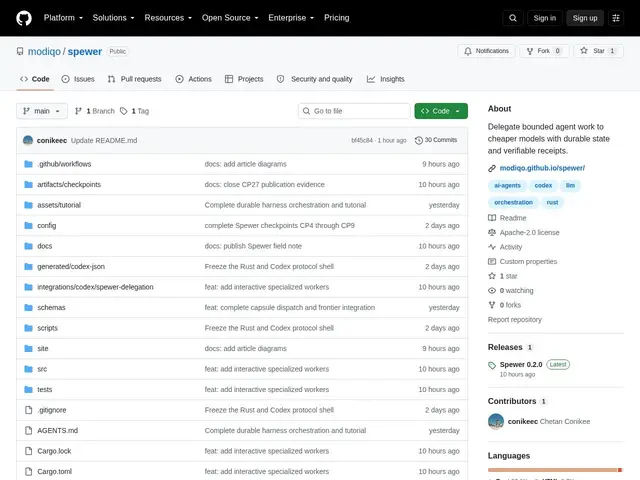
Description
Running every single step of an AI coding session through a frontier model is expensive when a lot of that work — running a search, formatting output, checking a simple condition — doesn't actually need frontier-level reasoning. Spewer sits alongside your coding assistant and gives it a way to hand off exactly those bounded, well-defined tasks to a cheaper model, while keeping the expensive model in charge of the parts that need real judgment.
Spewer is a Rust-based local service (Apache 2.0) that acts as a worker pool for AI coding harnesses — Codex, Claude Code, Kimi — letting them delegate bounded tasks to cheaper commodity models, either a local model via Ollama (like Qwen3) or a cheaper hosted model through the Codex App Server. It maintains a durable task queue with evidence-rich receipts so you can verify what a delegated task actually did, runs a configurable pool of concurrent workers, and sandboxes work read-only by default unless a task is explicitly granted web-search or write authority. It handles cases where a delegated task needs human input, with a 30-minute timeout, and tracks cost through a price-config file. It launched August 29, 2026, so multi-harness support and distributed workers are still on the roadmap rather than fully built.
💬 Our review
The short version: Spewer is a cost-control layer for people running AI coding agents heavily enough that model spend actually matters — worth setting up if you're burning frontier-model tokens on tasks that don't need frontier reasoning, not worth the setup effort for occasional or light usage.
It's conceptually similar to what OpenRouter or LiteLLM do for routing API calls to cheaper models, but Spewer operates at a different layer: instead of routing a single API call, it lets your coding harness delegate whole bounded sub-tasks to a worker pool, with a durable queue and receipts to audit what happened, and it runs locally rather than as a hosted proxy. Because it launched literally a day before this listing, treat it as very early — the core idea (delegate cheap, verifiable sub-tasks; keep judgment calls on the expensive model) is sound, but multi-harness support and distributed workers aren't finished yet. Worth trying if you're already deep into local-first AI coding workflows and comfortable with bleeding-edge tools; wait a few months if you want something stable. <!-- ai-generated -->
💰 Pricing
📊 Global score
🤖 AI-enriched data
Open source (Apache 2.0), gratuit — coût variable selon le modèle worker utilisé
Pros
délègue les tâches simples à des modèles moins chers (local via Ollama ou hébergé)
file d'attente durable avec reçus vérifiables pour auditer les tâches déléguées
sandboxing en lecture seule par défaut, sécurité par défaut
pool de workers concurrents configurable
open source (Apache 2.0)
Cons
tout jeune (lancé le 29 août 2026), support multi-harnais et workers distribués pas encore finalisés
nécessite de faire tourner un service local supplémentaire à configurer
gain réel dépend fortement du volume d'usage du harnais de code