Corsair
Open-source integration layer that connects your app (or your AI agent) to Slack, Gmail, Zendesk and ~70 other tools through one consistent API.
🔗 Visit Corsair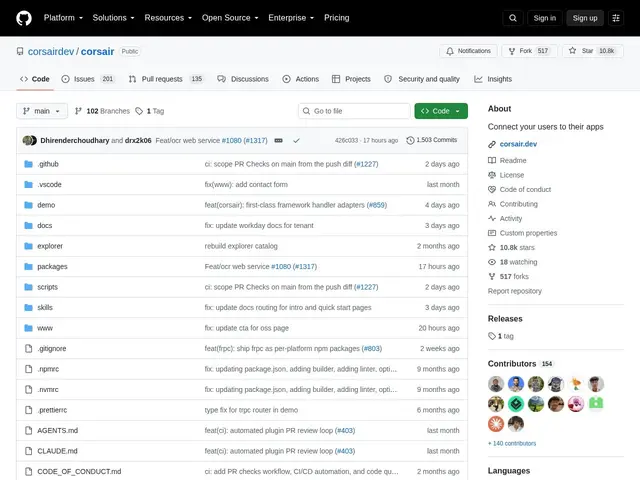
Description
Every time a product needs a new third-party integration — Slack, Gmail, Zendesk, whatever's next — someone has to learn that service's specific API, handle its OAuth flow, and keep it working as that API changes. Do that a dozen times and you've built a small integrations team by accident. Corsair is built to remove that repetition: one consistent syntax for every integration, with Corsair maintaining the actual adapters behind the scenes.
Corsair is an open-source, self-hostable integration platform built on a REST API foundation, so the same integration layer works whether you're wiring up an AI agent, a backend service, or a customer-facing dashboard where your own users connect their own apps. It currently ships roughly 70 plugin packages, each covering one integration (Slack, Gmail, Zendesk, and others), all using the same unified syntax rather than each having its own bespoke API shape. You can self-host it entirely for free, or use the managed Hub option if you'd rather not deal with OAuth token refresh and webhook infrastructure yourself. It's built as a Node.js/TypeScript monorepo, Apache 2.0 licensed, with an active community (10.8k+ GitHub stars).
💬 Our review
The short version: if you're building anything that needs to connect to multiple third-party apps — an AI agent, an internal tool, a customer dashboard — Corsair saves you from writing and maintaining a pile of one-off API integrations, and being open source and self-hostable means there's no per-integration platform tax if you're willing to run it yourself.
Nango, Paragon, and Merge.dev solve the same fundamental problem — unified integration access instead of bespoke API code per service — but they're commercial, hosted-first products with usage-based pricing that can get expensive as you add integrations or scale connection volume. Corsair's open-source, self-hosted-first model is the real differentiator: you can run it for the cost of your own infrastructure, and only pay if you choose the managed Hub for convenience. The tradeoff is that self-hosting means you own OAuth token refresh, webhook reliability, and updates yourself unless you pay for Hub. Worth it for technical teams comfortable running infrastructure who want to avoid recurring integration-platform fees; the hosted competitors remain simpler if you'd rather pay to not think about any of this. <!-- ai-generated -->
💰 Pricing
📊 Global score
🤖 AI-enriched data
Gratuit en auto-hébergé (open source, Apache 2.0) ; option Hub gérée payante sur devis
Pros
~70 intégrations disponibles derrière une syntaxe unifiée
fonctionne pour agents IA, backends ET dashboards clients
open source et auto-hébergeable gratuitement
option Hub gérée si on ne veut pas gérer OAuth/webhooks
communauté active (10.8k+ stars), licence Apache 2.0
Cons
auto-hébergement = responsabilité du refresh OAuth, des webhooks et des mises à jour
moins d'intégrations que des acteurs commerciaux plus établis (Merge.dev)
documentation/écosystème encore jeune comparé aux concurrents commerciaux