Zuke
Open-source, type-safe build automation system for Deno and TypeScript, letting you define build targets as ordinary TypeScript instead of YAML or a custom DSL.
🔗 Visit Zuke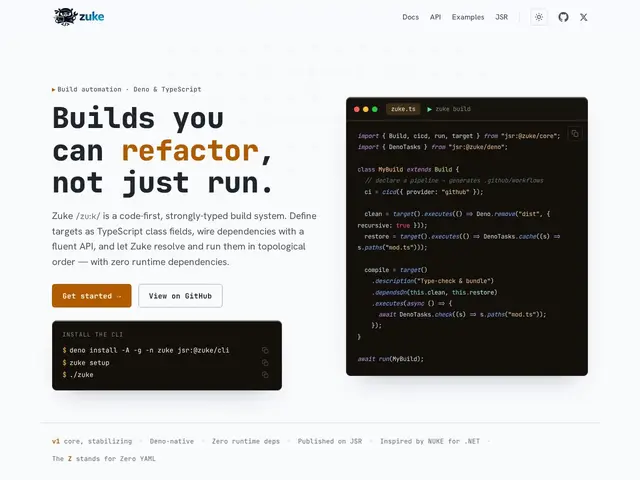
Description
Build tools traditionally make you choose between a rigid YAML file or a bespoke domain-specific language, both of which tend to break silently when you rename a target and forget to update every reference to it. Zuke's fix is simple in concept: define build targets as plain TypeScript class fields, so your editor and compiler catch broken dependencies before you ever run the build.
Zuke runs natively on Deno with zero runtime dependencies, resolves target dependencies automatically in topological order, and ships 54+ pre-built wrappers for common tools (Docker, Kubernetes, Terraform, Jest, Vitest and more). It can generate CI/CD configuration for GitHub Actions, GitLab CI or Azure Pipelines directly from your build definitions, includes OpenTelemetry-based observability, and has an unusual self-healing feature that lets a build failure trigger an AI-assisted diagnosis (Claude, OpenAI Codex or Gemini, with configurable cost controls) via a recoverWith() hook.
💬 Our review
The short version: Zuke is a genuinely interesting, well-built take on code-first build automation, worth trying if you're already on Deno/TypeScript, but it's a young, single-ecosystem tool going up against decades-old giants like Gradle, Maven and Bazel that have vastly more battle-testing and plugin ecosystems.
Its closest philosophical relative is NUKE for .NET (cited as inspiration), typed builds instead of YAML, and that comparison is a fair one: if you value compile-time-checked dependencies over a build config that only fails at runtime, Zuke delivers that for the Deno/TypeScript world specifically. It's free and open-source with an OpenSSF Best Practices badge, a good signal for security hygiene, but at 33 stars it's nowhere near the ecosystem depth of Gradle or Bazel, and it's fundamentally locked to Deno/TypeScript, not an option for Python, Go or Java projects.
💰 Pricing
📊 Global score
🤖 AI-enriched data
Open-source, gratuit ; fonctionnalités IA optionnelles = coût de clé API externe
Pros
sécurité de type complète, refactoring sans risque de casser une dépendance
pas de YAML/DSL, juste des fonctions TypeScript classiques
54+ intégrations d'outils préconstruites (Docker, Kubernetes, Terraform, tests...)
génère automatiquement les configs CI/CD (GitHub Actions, GitLab CI, Azure Pipelines)
badge OpenSSF Best Practices, observabilité OpenTelemetry intégrée
Cons
limité à l'écosystème Deno/TypeScript (pas Python, Go, Java...)
communauté restreinte (33 étoiles) face à Gradle, Maven, Bazel
projet récent, moins de retours de production que les alternatives établies
distribué via JSR et non npm, friction d'adoption possible
fonctionnalités IA (self-healing) impliquent des coûts d'API externes