Browser Agent
Open-source browser automation library that uses AI models to complete web tasks (form filling, data extraction, workflows) via TypeScript or Python SDKs, supporting multiple LLM providers.
🔗 Visit Browser Agent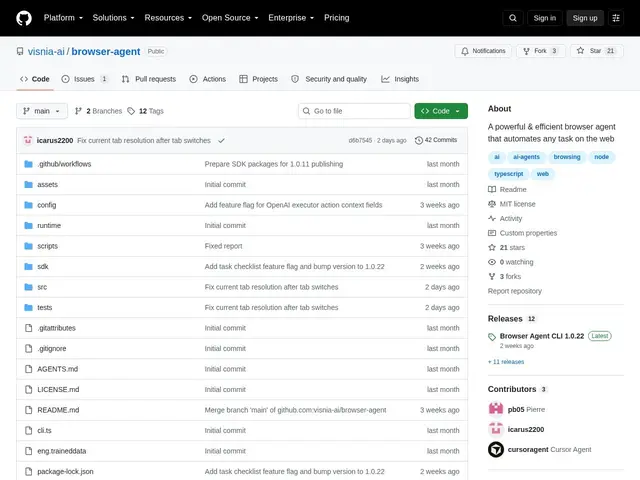
Description
AI-driven browser automation, pointing a language model at a web page and letting it figure out how to fill a form or extract data, has become a popular alternative to writing brittle CSS-selector scripts by hand. Browser Agent is an open-source entry in that space, giving developers TypeScript and Python SDKs to script AI-guided browser tasks against Chrome and Chromium.
It works with a range of LLM providers (OpenAI, Anthropic, Google, Together, OpenRouter, vLLM), so you're not locked into one model vendor, and includes encrypted credential handling, event streaming to track task progress, and built-in OCR for reading text from images or non-standard page elements. The published benchmark for its code-generation variant reports a 31% task success rate, against 78% for the more established Browser Use project on the same benchmark, a number worth knowing before you build on it.
💬 Our review
The short version: Browser Agent is a legitimate, MIT-licensed open-source project with decent multi-provider LLM support, but its own published benchmark shows meaningfully lower reliability (31%) than the category leader Browser Use (78%), so treat it as an early-stage alternative rather than a drop-in replacement.
Browser Use is the clear reference point in AI browser automation right now, with far more community validation; Browser Agent's honest disclosure of its own lower benchmark score is actually a point in its favor for trustworthiness, but it also means you should expect more manual intervention and failure-handling if you adopt it today. It's free either way, so the real cost is engineering time spent working around its current reliability gap, worth it only if you have a specific reason (provider flexibility, OCR built in) to prefer it over Browser Use.
💰 Pricing
📊 Global score
🤖 AI-enriched data
Open-source, gratuit + coûts d'API du fournisseur IA choisi
Pros
gratuit, open-source, licence MIT
supporte de nombreux fournisseurs LLM (OpenAI, Anthropic, Google, Together, OpenRouter, vLLM)
SDKs TypeScript et Python
gestion chiffrée des identifiants, OCR intégré
benchmarks publiés en toute transparence (même défavorables)
Cons
taux de réussite benchmark faible (31% vs 78% pour Browser Use)
Chrome/Chromium uniquement, pas de Firefox ni Safari
projet early-stage (21 étoiles, activité limitée)
nécessite des clés API de fournisseur IA (coût supplémentaire)