pyrig
Open-source Python project automation tool that scaffolds new projects with pre-configured linting, testing, CI/CD pipelines and dev tooling, so you don't set that up by hand each time.
🔗 Visit pyrig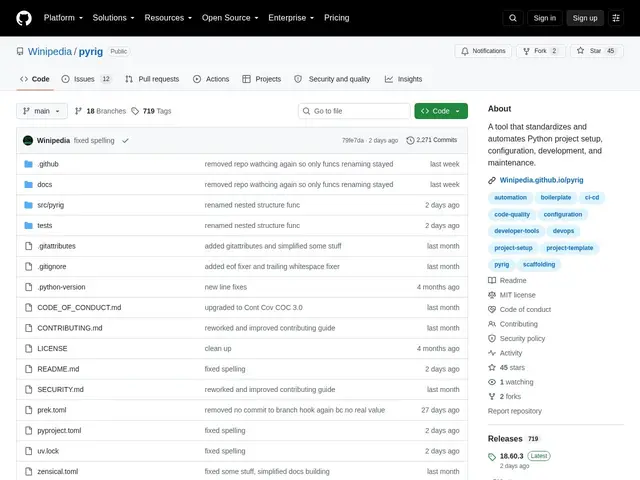
Description
Starting a new Python project usually means repeating the same setup ritual, pick a linter, configure a formatter, wire up a test runner, write CI/CD YAML, add Git hooks, and it's easy to end up with every project configured slightly differently. pyrig takes an opinionated, convention-over-configuration approach: run it once and get a fully scaffolded project with all of that already wired together.
It sets up integrated linters, formatters, type checkers and testing frameworks, pre-configured Git hooks, and complete GitHub Actions CI/CD pipelines with repository protection rules, all generated automatically. A mirror test system keeps test files structurally aligned with source files, configuration is managed through validated data structures instead of loose config files, and a plugin system extends it further (PyPI publishing, building executables, container images, coverage uploads). It requires Python 3.12+ and the uv package manager.
💬 Our review
The short version: pyrig is a genuinely useful time-saver if you start a lot of Python projects and want them consistently configured, but its own maintainer is upfront that the opinionated, no-toggles design makes migrating away from it later a real cost, so it's a bigger commitment than a typical scaffolding tool.
Cookiecutter-style templates and manual setup are the usual alternatives; pyrig goes further by staying actively integrated into the project (CI/CD generation, mirrored tests, plugin system) rather than being a one-time template you copy and forget, which is more powerful but also more of a lock-in. It's free and open-source under MIT, so there's no cost barrier to trying it, but the Python 3.12+ and uv package manager requirements mean it won't fit every existing codebase without some adjustment first.
💰 Pricing
📊 Global score
🤖 AI-enriched data
Open-source, gratuit
Pros
réduit fortement le temps de configuration initiale d'un projet
approche convention-over-configuration assure une cohérence entre projets
pipelines CI/CD GitHub Actions générés automatiquement
génération automatique de squelettes de tests miroir du code source
système de plugins extensible (publication PyPI, exécutables, images conteneur)
Cons
approche opinionated avec peu d'options de personnalisation
migration hors de pyrig difficile une fois le projet dépendant
nécessite Python 3.12+ et le gestionnaire de paquets uv
uniquement pour Python, pas d'usage polyglotte
adoption encore modeste (45 étoiles)