Telem AI
Infrastructure API that gives AI agents reliable web search and page-fetching, with multi-provider routing and automatic failover.
🔗 Visit Telem AI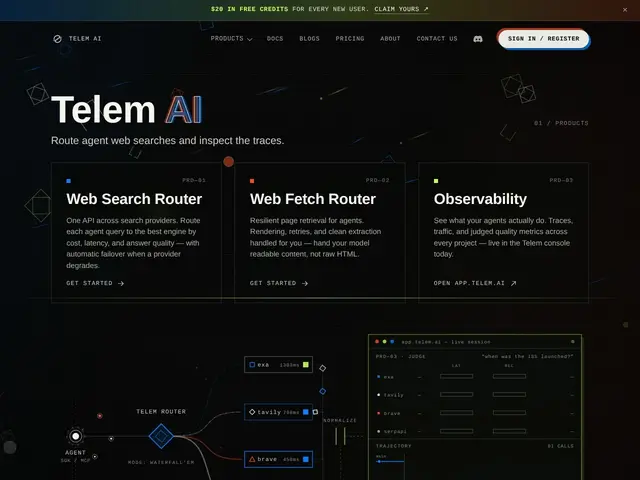
Description
AI agents that need to browse the web or search for information run into an unglamorous but real problem: search and fetch APIs from different providers vary wildly in reliability, cost, and how well they handle modern JavaScript-heavy pages, and building your own routing/failover logic across several of them is tedious plumbing work nobody wants to own. Telem AI exists to be that plumbing, so developers can just call one API and get web search or page content back reliably.
Telem AI provides a Web Search Router that picks between multiple underlying search providers optimizing for cost, latency, and answer quality, and a Web Fetch Router that renders and extracts content from web pages with retry logic for flaky sites. Both include automatic failover if a provider degrades, plus an observability console with traces and traffic analytics. It's delivered as a drop-in REST API with SDKs, requiring minimal code changes to integrate into an existing agent.
💬 Our review
The short version: Telem AI is a sensible bit of infrastructure for anyone building AI agents that need web access, letting you skip building your own multi-provider routing and failover logic, the free credit makes it cheap to validate before committing.
Developers building agents today often reach directly for a single provider (Tavily, Serper, or Bing's API) and eat the reliability risk when that one provider has issues; Telem AI's pitch is specifically the routing and failover layer on top of multiple providers, which is a real time-save if you'd otherwise build it yourself. Pay-as-you-go pricing tied to upstream provider rates means there's no markup lock-in to worry about, and the $20 free credit (roughly 4,000+ queries) is generous enough to properly test it against your actual workload before deciding.
💰 Pricing
📊 Global score
🤖 AI-enriched data
Tarifs des providers upstream, $20 de crédit gratuit
Pros
route et bascule automatiquement entre plusieurs providers de recherche/fetch web
pricing à l'usage, pas de sur-marge cachée
$20 de crédit gratuit à l'inscription, pas de CB requise
API REST drop-in avec SDKs
console d'observabilité (traces, analytics)
Cons
dépend de la fiabilité des providers sous-jacents qu'il route
pas d'infrastructure propre si tous les providers underlying sont down
jeune produit, peu de retours d'usage à grande échelle