KinoPipe
Hosted FFmpeg video editing API with 48 typed operations, built for AI agents and developers to trim, resize, and caption video via REST or MCP.
🔗 Visit KinoPipe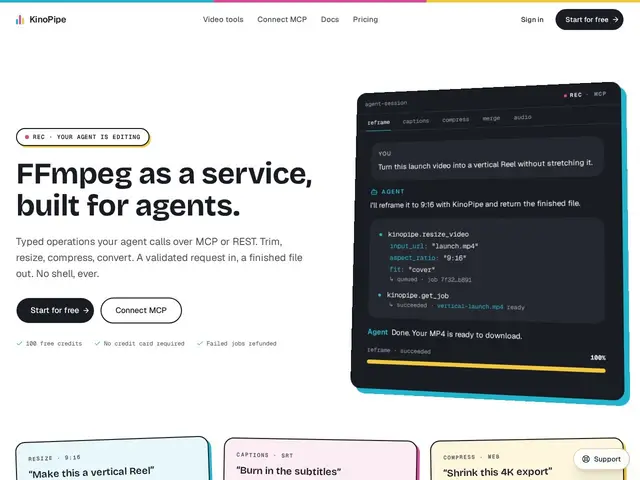
Description
Editing video programmatically usually means wrestling with FFmpeg's notoriously cryptic command-line syntax, and getting it wrong can silently degrade quality through repeated re-encoding. KinoPipe packages that power behind a simple, well-defined API: instead of writing shell commands, you call clearly named operations like 'trim' or 'add captions' and get back a processed video, run on fast servers so you don't need your own video infrastructure.
KinoPipe exposes 48 typed video operations, trimming, resizing, compression, caption overlay, scene splitting, format conversion, via a REST API, an MCP integration for AI tools like Claude, ChatGPT, Cursor, and n8n, or a browser-based playground for manual testing. Everything runs on GPU-accelerated FFmpeg 9 workers with single-pass rendering to avoid the quality loss that comes from chained re-encodes, with typical 1080p edits completing in about 8.2 seconds. Failed jobs are automatically refunded.
💬 Our review
The short version: KinoPipe is a well-built convenience layer over FFmpeg specifically aimed at AI agent workflows, worth using if you're wiring video processing into an agent and don't want to run your own FFmpeg infrastructure.
Compared to rendi, another hosted FFmpeg API, KinoPipe's differentiators are its native MCP integration (so tools like Claude or Cursor can call it directly) and its emphasis on typed, validated operations rather than raw shell access, which reduces the chance of malformed commands. Pricing is credit-based and reasonably generous at the free tier (100 credits, no card), and automatic refunds on failed jobs is a fair, low-friction policy. If you're already comfortable running your own FFmpeg pipeline and don't need agent integration, self-hosting remains cheaper at real scale, KinoPipe's value is mainly speed-to-integrate for AI-driven workflows.
💰 Pricing
📊 Global score
🤖 AI-enriched data
100 crédits gratuits, puis $12-$99/mois selon le volume, packs one-time disponibles
Pros
48 opérations vidéo typées, pas de syntaxe FFmpeg à écrire
rendu single-pass, pas de perte de qualité par ré-encodages chaînés
intégration MCP native (Claude, ChatGPT, Cursor, n8n)
remboursement automatique des jobs échoués
palier gratuit sans CB (100 crédits)
Cons
moins économique que du FFmpeg auto-hébergé à grande échelle
dépendance à un service tiers pour une brique cœur du pipeline vidéo
système de crédits à surveiller pour les gros volumes