NodeAkt
Zero-dependency, TypeScript-first actor framework for concurrent and distributed Node.js systems.
🔗 Visit NodeAkt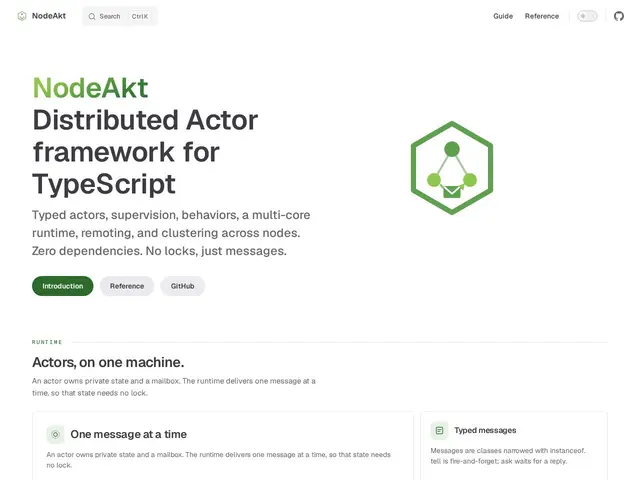
Description
Writing code that safely juggles many things happening at once, without race conditions and without manually managing locks, is one of the classic hard problems in programming. NodeAkt brings a decades-old solution called the actor model to modern JavaScript, letting each unit of your program own its own state and only talk to others by sending messages.
NodeAkt is a zero-dependency, TypeScript-first distributed actor framework for Node.js, Bun, and Deno. It provides typed actors, configurable supervision strategies for fault tolerance such as stop, resume, restart, and escalate, multiple mailbox types including FIFO, bounded, and priority, remote TCP messaging with optional TLS, and full clustering support with automatic actor relocation and a distributed name registry. Open source under the MIT license.
💬 Our review
The short version: NodeAkt brings Erlang and Akka-style actor concurrency to TypeScript with zero dependencies, a solid pick if you're building a distributed Node.js system and want battle-tested concurrency patterns instead of hand-rolled state machines.
The obvious reference points are Akka, the actor model's most famous implementation on the JVM, Proto.Actor, cross-language across Go, C#, and JS, and Microsoft's Orleans on .NET. NodeAkt's pitch is being genuinely native to the JavaScript runtime ecosystem, Node, Bun, and Deno, with zero external dependencies, which matters if you don't want to pull in a JVM or .NET dependency just to get actor-model concurrency in a TypeScript codebase. It's free and open source, so there's no cost question, but at only a couple of stars it's extremely early. The ideas around supervision, clustering, and mailboxes are sound and modeled on proven systems, but you'd be an early adopter, not joining an established community.
💰 Pricing
📊 Global score
🤖 AI-enriched data
Open source (licence MIT)
Pros
Zéro dépendance
Nativement TypeScript sur Node.js, Bun et Deno
Tolérance aux pannes intégrée via stratégies de supervision
Clustering multi-nœuds avec relocalisation automatique des acteurs
Gratuit et open source
Cons
Projet très jeune (2 stars), petite communauté
Pas encore de retour d'expérience en production à grande échelle
Le modèle acteur demande une courbe d'apprentissage si l'équipe ne le connaît pas