StreamCore
Open-source, self-hostable server for building realtime voice AI applications end to end.
🔗 Visit StreamCore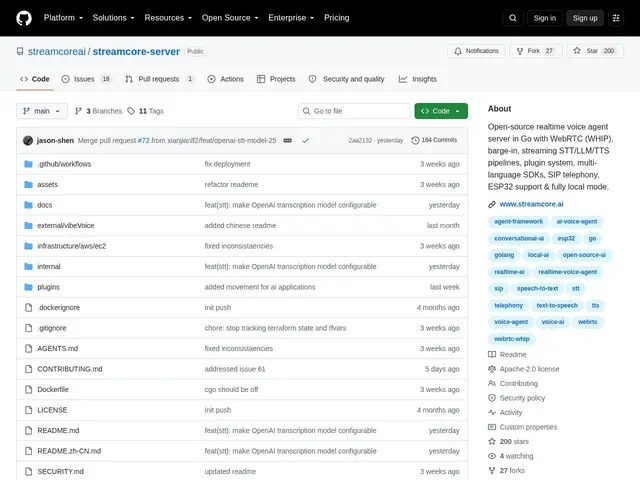
Description
Building an app where someone can just talk to an AI and get a natural, low-latency voice response instead of typing usually means wiring together a maze of separate services for audio streaming, speech-to-text, the AI model itself, and text-to-speech. StreamCore packages that entire pipeline into one open-source server you can run yourself.
StreamCore is a Go-based, open-source realtime voice AI server that handles WebRTC audio connectivity via the WHIP protocol, with a built-in STUN/TURN server, voice activity detection, interruption and barge-in handling, and a full streaming speech-to-text, LLM, text-to-speech pipeline. It supports browsers, mobile, CLI, SIP telephony, and even ESP32 embedded devices as endpoints, and can run entirely locally with no API keys or cloud dependency. Apache 2.0 licensed and free.
💬 Our review
The short version: if you're building a voice AI product and don't want to be locked into a single cloud voice API, StreamCore gives you a self-hostable, free alternative that handles the hard real-time audio plumbing for you.
The natural comparisons are hosted platforms like Twilio, telephony-focused and paid per minute, and Daily.co, WebRTC infrastructure that's also paid, or going directly against OpenAI's Realtime API, powerful but cloud-only and metered. StreamCore's differentiator is that it's free, open source, and can run fully local, which matters a lot for cost control at scale or for privacy-sensitive use cases like healthcare or internal tools. The trade-off is operational: you're now responsible for hosting and scaling it yourself, and with around 200 stars it's newer and less battle-tested than Twilio's decade of production hardening. For teams comfortable self-hosting infrastructure, it's a strong free starting point; for teams that just want an API to call, a hosted provider will get you there faster.
💰 Pricing
📊 Global score
🤖 AI-enriched data
Open source (licence Apache 2.0), autohébergé — aucun frais d'usage
Pros
Pipeline complet STT-LLM-TTS dans un seul serveur
Peut fonctionner entièrement en local/hors-ligne
Compatible navigateur, mobile, CLI, SIP et même ESP32
Gratuit et open source (Apache 2.0)
Système de plugins Python, TypeScript, Go
Cons
Vous hébergez et opérez vous-même — pas d'option cloud managée
Projet plus jeune que les plateformes de téléphonie commerciales
Nécessite des compétences WebRTC/réseau pour un bon déploiement