Boop
Self-hosted push notification service that turns your app's events into iPhone alerts.
🔗 Visit Boop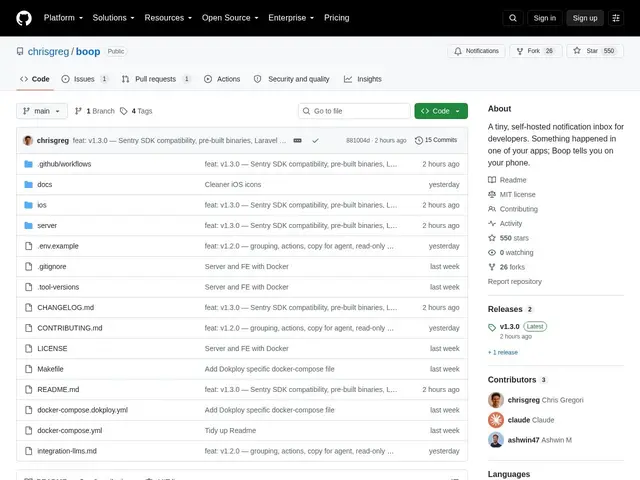
Description
When something breaks in production, you want to know about it on your phone in seconds, not by checking a dashboard later. Boop is a small, self-hosted service that turns any event from your own app, an error, a deploy, a low-stock alert, anything, into a push notification straight to your iPhone.
Boop is a single Go binary with an embedded SQLite database that receives events over HTTP, automatically redacts sensitive fields like API keys, groups similar events by fingerprint to avoid notification spam, and delivers push notifications directly via Apple Push Notification service, no third-party relay or telemetry involved. It's compatible with the Sentry SDK's DSN protocol, so many existing error-tracking integrations work out of the box, and it exposes an MCP interface for AI agent integration too.
💬 Our review
The short version: Boop is a genuinely simple, free, privacy-respecting way to get push notifications from your own backend without handing your error data to a third-party SaaS.
The closest alternatives are Gotify, ntfy, and Pushover, all self-hostable or low-cost push notification tools, but none of them speak the Sentry DSN protocol natively or ship a dedicated iOS app with rich action buttons the way Boop does. Since it's open source and self-hosted, there's no recurring cost, and no data leaves your own infrastructure, a real advantage over commercial error-tracking tools that route everything through their servers. The trade-off is Apple-only push delivery for now, with no Android app mentioned, and you're responsible for hosting the Go binary yourself. For an iOS-heavy team wanting fast, private alerts, it's hard to beat at the price of free.
💰 Pricing
📊 Global score
🤖 AI-enriched data
Open source, autohébergé, sans frais
Pros
Binaire Go unique avec base de données embarquée, déploiement trivial
Intégration directe Apple Push, sans service relais
Compatible SDK Sentry (remplacement direct pour le tracking d'erreurs existant)
Rédaction automatique des données sensibles
Gratuit et open source
Cons
Orienté Apple/iOS — pas d'application Android mentionnée
Autohébergement uniquement, pas d'option cloud managée
Communauté plus restreinte que des outils établis comme Pushover