Argus
Open-source AI agent that tests web apps using natural language instead of selector scripts.
🔗 Visit Argus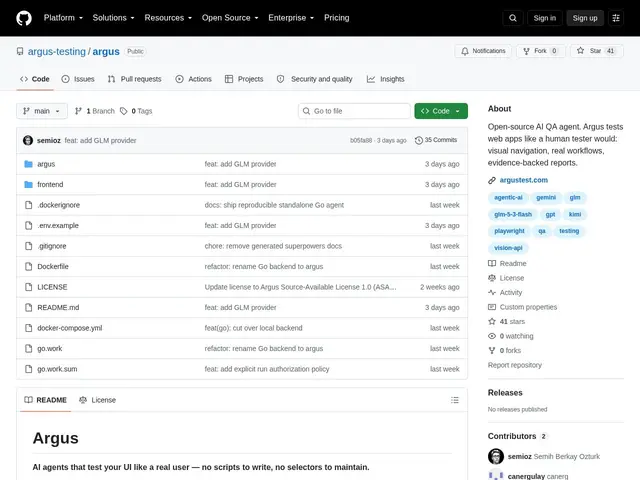
Description
Writing and maintaining automated tests for a website usually means writing brittle scripts full of CSS selectors that break every time the UI changes. Argus takes a different approach: you describe what you want tested in plain language, and an AI agent actually explores your app like a human would, then reports back with evidence.
Argus is an open-source AI testing agent built on Playwright that runs a six-stage pipeline, Validator, Comprehender, Explorer, Strategist, Executor, Critic, to break a described test into cases, explore the app, plan and execute steps in an isolated browser, and produce structured reports with screenshots and evidence timelines. It works on localhost and private networks, stores everything locally in SQLite with no telemetry, supports Gemini, OpenAI, Kimi, and GLM model providers, and offers an MCP adapter. Source-available under ASAL-1.0: free for individuals and teams under 100 people, commercial license required above that, converting to MIT after three years.
💬 Our review
The short version: Argus is a genuinely different take on web testing, natural-language test descriptions instead of selector scripts, free for small teams, with a real commercial license kicking in only once you're a sizeable company.
The established players here are Playwright, Selenium, and Cypress, all script-based frameworks requiring you to write and maintain selectors, while testRigor is the closest existing product doing natural-language, no-selector testing. Argus's edge is being source-available and running locally with zero telemetry, which testRigor, a paid SaaS, doesn't offer. Since Argus is built on Playwright under the hood rather than replacing it, teams get the reliability of a mature browser automation engine with a more resilient testing layer on top. For teams under 100 people it's genuinely free, making it low-risk to try against an existing brittle Selenium or Cypress suite.
💰 Pricing
📊 Global score
🤖 AI-enriched data
Gratuit pour individus et équipes de moins de 100 personnes ; licence commerciale requise au-delà (passe en MIT après 3 ans)
Pros
Description des tests en langage naturel, aucun sélecteur à maintenir
Pipeline IA en six étapes avec rapports de preuves structurés
Construit sur Playwright pour une automatisation de navigateur fiable
Stockage local, aucune télémétrie applicative
Gratuit pour les équipes de moins de 100 personnes
Cons
Licence commerciale requise à partir de 100 membres
Dépend de fournisseurs LLM externes (Gemini, OpenAI, etc.) pour le raisonnement IA
Projet plus récent (41 stars) que Playwright/Selenium