DMX
Open-source MCP server adding a structured, human-gated workflow on top of AI coding agents.
🔗 Visit DMX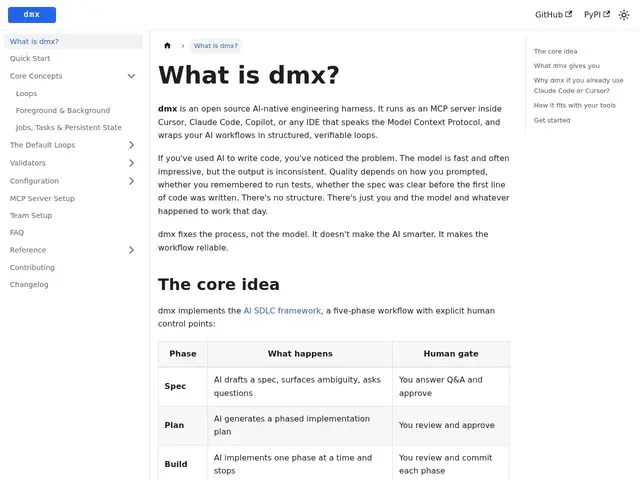
Description
AI coding agents are great at writing code fast, but fast and consistent, reviewable, auditable don't always go together. DMX adds a structured process on top of tools like Claude Code or Cursor, so AI-written code goes through defined stages with a human checkpoint before it ships.
DMX is an open-source MCP server implementing a five-phase AI software development lifecycle, Spec, Plan, Build, Validate, Release, with mandatory human approval gates and automated validators between phases. It integrates with Claude Code, Cursor, Copilot, and Antigravity, persists a memory bank in a version-controlled directory, and supports job tracking and session resumption so context isn't lost between work sessions. Free and open source under AGPL-3.0.
💬 Our review
The short version: DMX is a free, opinionated workflow layer for teams who want AI coding agents to follow a repeatable process instead of freewheeling, useful if move-fast AI coding has started producing code nobody fully reviewed.
This isn't really competing with the AI coding agents themselves, Claude Code, Cursor, Copilot, it's a governance layer that sits on top of them, closer in spirit to a lightweight version of what a tool like Conduct AI does for policy enforcement, but focused specifically on development workflow stages rather than security policy. Since it's free, open source, and works as an MCP server, meaning it plugs into whatever coding agent you already use, there's minimal switching cost to try it. The AGPL-3.0 license is worth noting for companies with strict open-source policies, since it's more restrictive than MIT or Apache for derivative works.
💰 Pricing
📊 Global score
🤖 AI-enriched data
Open source (licence AGPL-3.0), aucune offre payante
Pros
Workflow en cinq phases (Spec, Plan, Build, Validate, Release) avec validation humaine
Fonctionne avec Claude Code, Cursor, Copilot, Antigravity via MCP
Mémoire persistante versionnée
Reprise de session sans perte de contexte
Gratuit et open source
Cons
Licence AGPL-3.0 plus restrictive que MIT pour certaines entreprises
Ajoute de la friction de process — pas pour les équipes voulant zéro friction
Projet très jeune (2 stars)