Olostep
A service that turns any webpage into clean, structured data an AI program can actually use, at the scale of thousands of pages at once.
🔗 Visit Olostep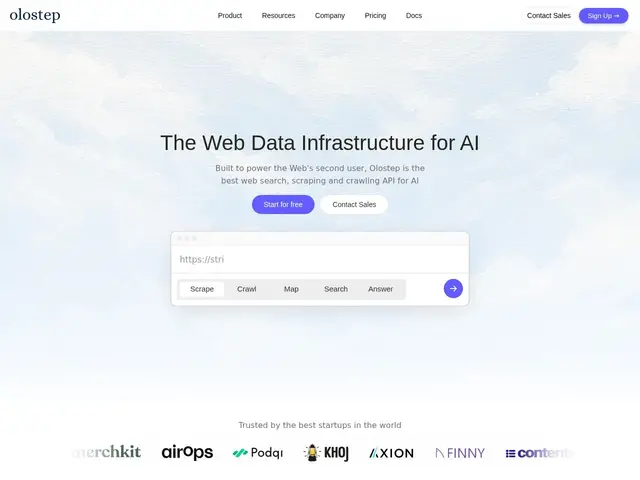
Description
If you've ever tried to have a computer program "read" a webpage, you know the page you see in your browser isn't what a program sees — it's a tangle of ads, menus, scripts and formatting. Olostep does the cleanup work: point it at a URL (or thousands of them at once) and it hands back the actual content as clean text, structured JSON, or even a screenshot, ready to feed into an AI model or a spreadsheet.
Olostep is a web data API built for AI teams and developers who need to search, crawl, and scrape the live web at scale. It renders JavaScript-heavy pages, gets past common anti-bot defenses, and can batch-process up to 10,000 URLs in five to eight minutes with webhook notifications when a job finishes. Output formats include Markdown, HTML, JSON, screenshots and PDFs, and it ships official SDKs for Python and Node.js plus a CLI, REST API, and an MCP server so it plugs directly into Claude, Cursor or VS Code. It also offers an AI-powered web search/Q&A endpoint with citations, and no-code integrations with n8n, Make, Zapier and Relay. Pricing runs from a 500-request free tier up to a $399/month Scale plan (1M requests), with pay-as-you-go credit packs and custom Enterprise deals above that.
💬 Our review
The short version: if you're building an AI agent, a research tool, or a sales/SEO workflow that needs to reliably pull structured data off the live web — including sites that fight back with JavaScript rendering and bot detection — Olostep does that job so you don't have to maintain your own scraping infrastructure.
The category of "web data for AI" is crowded (Firecrawl, Apify, ScrapingBee, Browserless all compete here), and Olostep's pitch is speed and batch scale: 10,000 URLs in under 10 minutes is a genuinely useful number if you're building something like a competitive-intelligence dashboard or bulk lead enrichment. The free tier (500 requests/month) is generous enough to actually evaluate the product before paying, and the MCP server support means it slots into an existing Claude Code or Cursor workflow with minimal glue code. The catch is that this is infrastructure, not a finished product — you're still writing the code that calls the API and does something with the output, so it's a poor fit if you just want one page scraped occasionally rather than a pipeline. Best suited for developers and AI teams with an actual scraping or data-collection workload, not casual one-off use.
💰 Pricing
📊 Global score
🤖 AI-enriched data
Gratuit : 500 requêtes/mois. Starter 9$/mois (5K). Standard 99$/mois (200K). Scale 399$/mois (1M). Enterprise sur devis. Packs de crédits à l'usage disponibles.
Pros
Traite jusqu'à 10 000 URLs en 5 à 8 minutes
Gère le rendu JavaScript et les protections anti-bot
Serveur MCP natif pour Claude, Cursor, VS Code
Formats de sortie multiples : Markdown, JSON, capture d'écran, PDF
Cons
Nécessite de coder l'intégration — pas un outil clé en main
Marché déjà occupé par Firecrawl, Apify et d'autres
Peu pertinent pour un usage ponctuel non répété