Marillo
A tool that lets you ask your company's live database a question in plain English — like "which customers ordered the most last month?" — instead of writing SQL yourself.
🔗 Visit Marillo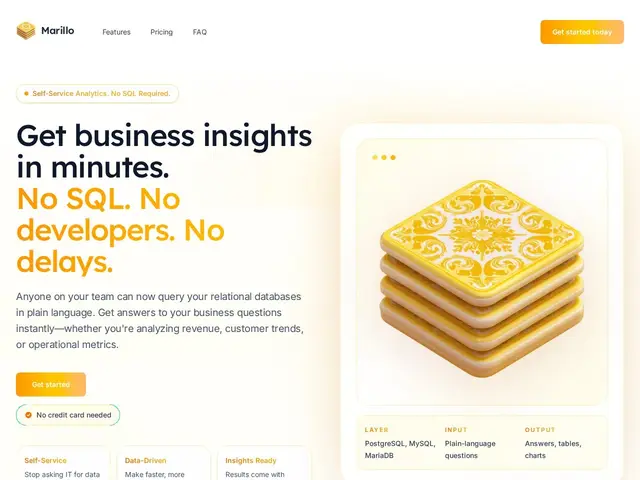
Description
Getting an answer out of a production database usually means either knowing SQL or waiting for someone who does. Marillo connects directly to your existing PostgreSQL, MySQL or MariaDB database, reads its structure, and translates a plain-language question straight into the SQL needed to answer it — then hands back a table, chart or CSV instead of raw rows.
Marillo is a natural-language database assistant that connects to relational databases, automatically understanding schema and table relationships to generate accurate SQL behind the scenes. Each query runs in an isolated container rather than a shared environment, database credentials are encrypted, and the underlying data itself is not stored by Marillo — only the generated results pass through. It includes table and column-level access controls so sensitive data can be restricted per user, and supports multiple simultaneous database connections depending on plan. Pricing is token-based: a free tier includes one database connection, 20 tokens and 24-hour chat history at no cost, while an Enterprise tier offers custom pricing for high-volume usage with dedicated support and 20-50% discounts on additional token purchases for subscribers.
💬 Our review
The short version: if your team has a real production database but not enough people who can write SQL confidently, Marillo lets non-technical staff get direct, live answers from that database instead of routing every question through an engineer.
This puts Marillo in the same natural-language-to-data space as Quiriz, but with an important distinction: Quiriz works from uploaded files (Excel, CSV, PDF), while Marillo connects directly to a live relational database — a meaningfully different (and higher-stakes) use case, since it's querying production data rather than exported snapshots. Per-query container isolation and not storing the underlying data are sensible security defaults for a tool that needs direct database credentials, which is the single biggest trust question any team should ask before connecting it to anything containing customer data. The free tier's 20-token, single-connection limit is really just enough to validate that the natural-language-to-SQL translation is accurate for your specific schema before paying — worth testing with a few known-answer questions first, since a wrong auto-generated SQL join on a complex schema could quietly produce a plausible-looking but incorrect number.
💰 Pricing
📊 Global score
🤖 AI-enriched data
Gratuit : 1 connexion DB, 20 jetons, historique 24h. Enterprise : sur devis, tarification par jetons avec remises de 20-50% pour abonnés.
Pros
Connexion directe à une base de données de production (Postgres, MySQL, MariaDB)
Chaque requête isolée dans un conteneur dédié
Ne stocke pas les données sous-jacentes, identifiants chiffrés
Contrôles d'accès par table et par colonne
Cons
Requêtes générées automatiquement à valider sur schémas complexes
Palier gratuit très limité (20 jetons)
Accès direct à la base = question de confiance/sécurité à évaluer sérieusement