ElseLane
A single API that automatically picks the right AI model for your request and switches to a backup provider if the first one is down or errors out, so your app doesn't break when one AI company has a bad day.
🔗 Visit ElseLane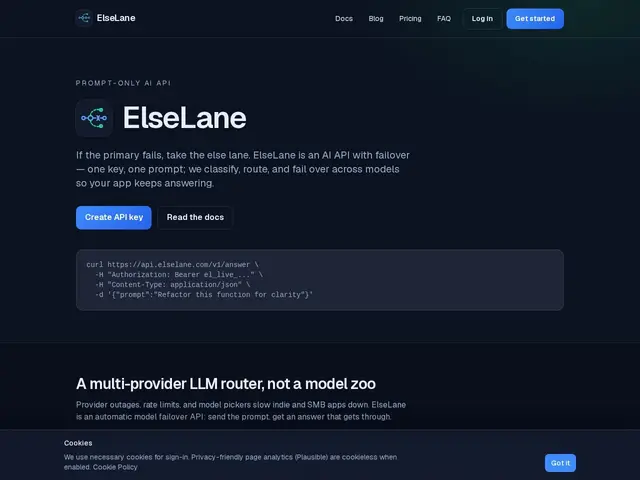
Description
Building a product on a single AI provider's API is risky: if OpenAI or Anthropic has an outage, rate-limits you, or a specific model errors out, your product breaks right along with it. ElseLane sits between your app and multiple AI providers, automatically choosing where to send each request and instantly retrying with a different provider if the first choice fails — without you writing any provider-switching logic yourself.
ElseLane exposes an OpenAI-compatible endpoint (`/v1/chat/completions` with `model: "auto"`) that classifies each incoming prompt and routes it across OpenAI, Anthropic, Google Gemini, Groq and Together, failing over automatically if a provider errors or times out. It includes PII guardrails that block sensitive data like SSNs, credit card numbers and API secrets from being sent out, supports streaming responses and idempotency keys, and returns metadata showing which provider and model actually handled each request along with a full attempt log. It runs on prepaid credits (1 credit = $0.0001), charging the estimated provider cost plus a 10% platform fee with a 10-credit minimum per request, sold in $10/$25/$50 packs — no monthly subscription. It works across Node.js, Python, Deno and Supabase Edge Functions, and explicitly does not offer an uptime SLA, since failover improves resilience but can't guarantee success if every underlying provider is down simultaneously.
💬 Our review
The short version: if you're an indie developer or small team who doesn't want to hand-roll fallback logic across multiple AI providers, ElseLane's auto-routing and failover buys you real reliability for a modest 10% markup over raw provider pricing.
This is a genuinely useful niche — LLM gateways with multi-provider failover (Portkey, LiteLLM, OpenRouter) are an established pattern, and ElseLane's specific angle is a prompt-only interface (no manual model picking) combined with built-in PII guardrails, which is a meaningful convenience if you don't want to build that safety layer yourself. The 10% platform fee is a reasonable price for not maintaining multi-provider glue code and failover logic in-house, though it's worth comparing against OpenRouter, which offers similar multi-provider access with a different fee structure and a much larger existing user base and model catalog. The no-SLA caveat is honest but means ElseLane isn't a drop-in replacement if you need contractual uptime guarantees for an enterprise deal — it's better suited to indie apps and side projects than mission-critical enterprise infrastructure at this stage.
💰 Pricing
📊 Global score
🤖 AI-enriched data
1 crédit = 0,0001$. Facturation = coût fournisseur estimé x1,10 (marge 10%), minimum 10 crédits/requête. Packs : 10$ (100K crédits), 25$ (250K), 50$ (500K). Aucun abonnement mensuel.
Pros
Basculement automatique entre 5 fournisseurs LLM en cas d'échec
Endpoint compatible OpenAI — pas de code de sélection de modèle à écrire
Garde-fous PII intégrés (bloque SSN, cartes bancaires, secrets)
Pas d'abonnement — paiement au crédit prépayé uniquement
Cons
Aucun SLA d'uptime contractuel proposé
Marge de 10% par rapport au prix fournisseur brut
Catalogue de fournisseurs plus restreint qu'OpenRouter