Dromeas
An AI reviewer that reads every pull request like a small team of specialists — one checking for bugs, another for security holes, another for missing tests — and gives you one clear verdict on whether it's safe to merge.
🔗 Visit Dromeas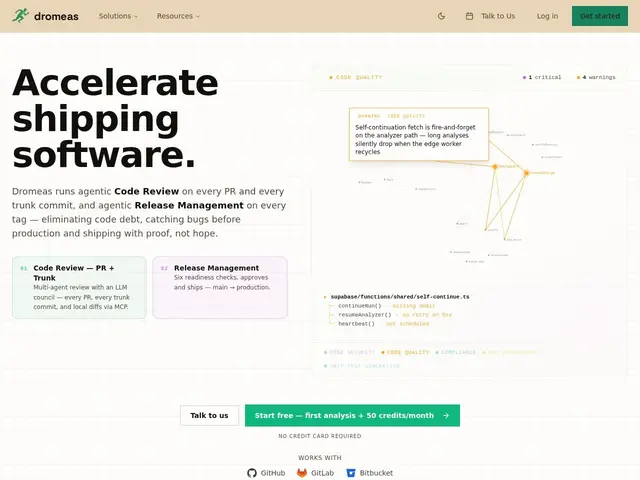
Description
Human code review doesn't scale well: reviewers get tired, miss things at the end of a long day, and rarely have time to check security implications, test coverage, and documentation on every single change. Dromeas automates that first pass by having several specialized AI "reviewers" look at each pull request from a different angle, then combining their findings into one merge-readiness verdict with inline comments.
Dromeas reviews every pull request and every commit to the default branch using a council of six specialist agents — covering quality, security, compliance, documentation, testing, and instrumentation — cross-checking each other's findings across multiple LLM providers (Anthropic, OpenAI, Google, DeepSeek) to reduce false positives. Beyond review, it offers a "Code Map" visualizing file and function relationships, blast-radius analysis to flag what a change might break, and agentic release management with auto-generated release notes. It integrates with GitHub, GitLab and Bitbucket, supports Model Context Protocol (MCP) for IDE integration, and allows bring-your-own-model for on-premises deployments. Pricing is credit-based rather than per-seat: a free tier includes 50 monthly credits and one public repo (with unlimited free access for open-source public repositories), while the Pro plan starts at $25/month with flexible credit packs (100–5,000) and unlimited public/private repos and collaborators.
💬 Our review
The short version: if your team's pull requests pile up faster than reviewers can get to them, or you maintain open-source repos and want free, thorough first-pass review, Dromeas's multi-agent approach and genuinely generous free tier for public repos make it worth trying before paying for anything.
AI code review is a crowded space (CodeRabbit, Greptile, GitHub Copilot's review features, SonarQube, Snyk all compete here), and Dromeas's differentiator is the explicit multi-agent "council" architecture with cross-provider verification — the idea being that having Claude, GPT, Gemini and DeepSeek cross-check each other catches more real issues and fewer false positives than a single model's opinion. The credit-based, no-per-seat pricing is genuinely friendlier for small or open-source teams than the seat-based pricing common in this category, and free unlimited access on public repos is a strong signal of confidence in the product. The tradeoff of running multiple LLM calls per review is cost and latency — worth confirming actual review turnaround time on a real-sized PR before committing a team workflow to it, and as with any AI review tool, it should complement rather than fully replace a human reviewer's judgment on architectural decisions.
💰 Pricing
📊 Global score
🤖 AI-enriched data
Gratuit : 50 crédits/mois, 1 repo public, jusqu'à 5 collaborateurs (accès gratuit illimité pour les repos open-source publics). Pro : 25$/mois, paliers de crédits flexibles (100-5000), repos et collaborateurs illimités.
Pros
Conseil de 6 agents spécialisés multi-fournisseurs (Anthropic, OpenAI, Google, DeepSeek)
Accès gratuit illimité pour les dépôts open-source publics
Tarification au crédit, pas au siège — plus adaptée aux petites équipes
Gestion de release agentique avec notes générées automatiquement
Cons
Coût/latence potentiellement plus élevés (plusieurs appels LLM par revue)
Marché très concurrentiel (CodeRabbit, Greptile, SonarQube)
Ne remplace pas le jugement humain sur les décisions d'architecture